Key Agreements From Prabowo’s Meetings With Singapore PM Wong, India’s Modi
Strategic Collaborations Strengthen Indo-Singapore and Indo-India Ties Key Agreements From Prabowo s Meetings - During the first week of July 2026, Indonesian
Strategic Collaborations Strengthen Indo-Singapore and Indo-India Ties
Tempatdonasi.com – During the first week of July 2026, Indonesian President Prabowo Subianto engaged in high-level diplomatic exchanges with leaders from Singapore and India. These interactions, spanning two days with Singapore’s Prime Minister Lawrence Wong and three days with India’s Prime Minister Narendra Modi, yielded significant agreements aimed at bolstering regional cooperation and economic integration. The discussions highlighted shared priorities in maritime security, educational exchanges, and energy partnerships, underscoring Indonesia’s proactive approach to strengthening ties with key international partners.
Indo-Singapore Dialogue: Focus on Maritime and Energy Initiatives
The bilateral meeting with Singapore’s Prime Minister Lawrence Wong took place on July 5-6, 2026, coinciding with the Annual Singapore-Indonesia Leaders’ Retreat in Jakarta. This event marked the second such summit since the last gathering in Singapore the previous year, when Prabowo and Wong had previously convened to discuss regional priorities. Cabinet Secretary Teddy Indra Wijaya emphasized that the retreat is a regular part of the two nations’ diplomatic calendar, reflecting their commitment to sustained collaboration.
As part of the retreat, 26 agreements were formalized between Indonesia and Singapore, covering a range of sectors. A key focus was the Malacca Strait, a critical maritime corridor for global trade. President Prabowo reaffirmed Indonesia’s dedication to preserving the strait as an international shipping route, while Singapore’s PM Wong confirmed Singapore’s alignment with this goal. “We must ensure security, peace, and environmental sustainability in the strait,” Prabowo stated after the meeting, underscoring the need for joint efforts to combat pollution, accidents, and piracy.
“We must maintain security, peace in the strait, and also security from pollution, accidents, and piracy,” he said after the meeting on Monday, July 6, 2026.
Prabowo further noted that Indonesia and Singapore will collaborate with Malaysia and Thailand to uphold the strait’s status under the United Nations Convention on the Laws of the Sea (UNCLOS 1982). This trilateral coordination is expected to enhance regional stability and facilitate smoother maritime traffic. In addition to security, the discussions included educational initiatives, with both nations agreeing to deepen diplomatic ties through youth engagement.
The partnership involves the Taruna Nusantara High School and the Garuda School, a program initiated by Prabowo to promote intercultural understanding. Wong highlighted that student exchange programs will play a pivotal role in fostering closer relations between the two countries. “We want to encourage more exchanges with the Garuda School so that our young people can learn from each other,” he remarked, emphasizing the program’s potential to build lasting friendships.
Meanwhile, the collaboration in electricity export emerged as another significant outcome. Prabowo confirmed that Indonesia has signed a comprehensive agreement with Singapore to explore cross-border energy trade. The Danantara Investment Management Agency, tasked with overseeing this initiative, has already inked three memoranda of understanding (MoUs) with Singapore-based energy companies. These agreements are designed to expedite the development of a project targeting 3.4 gigawatts of capacity by 2035.
Rosan Roeslani, head of Danantara, explained that the electricity exported to Singapore will originate from new power plant capacities, distinct from domestic supply. “This project is a catalyst for Indonesia’s green industrialization,” he said, noting that the interconnection with Singapore represents a broader strategic shift toward sustainable development. The initiative also includes an MoU with Singapore Energy Interconnection to streamline information sharing and technical cooperation in expanding the cross-border grid.
Indo-India Engagement: Cultural and Economic Synergies
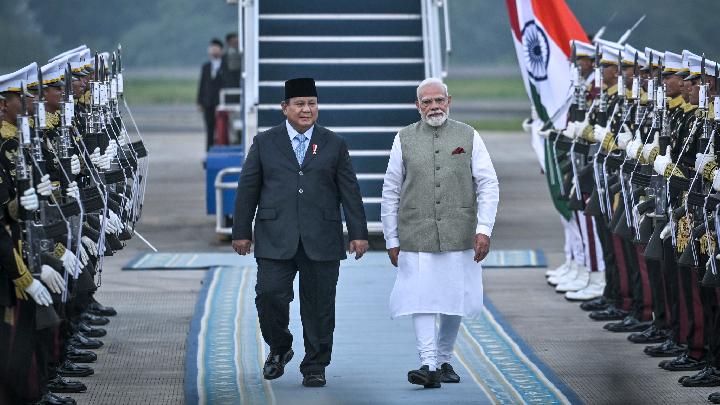
Following the Singapore discussions, Prabowo welcomed Prime Minister Narendra Modi’s arrival in Jakarta on July 6, 2026. The Indian delegation’s visit, which extended until July 8, included a series of engagements to solidify the India-Indonesia partnership. Modi’s itinerary encompassed both official meetings and cultural exchanges, with plans to visit the Prambanan Temple on July 8, as confirmed by Foreign Minister Sugiono.
Modi’s presence in the country also highlighted the importance of bilateral cooperation in energy and infrastructure. The meeting between Prabowo and Modi was expected to address shared interests in renewable energy projects and economic collaboration. While specific details of the agreements remain under review, the two leaders emphasized the potential for mutual growth and innovation.
Modi’s visit further underscored the significance of cultural diplomacy. The Prime Minister expressed enthusiasm for expanding educational ties, particularly through student exchanges. “Our nations can deepen connections by sharing knowledge and experiences,” Modi remarked, aligning with Prabowo’s vision of fostering closer relations through grassroots initiatives.
The Indo-Singapore and Indo-India agreements reflect a strategic shift in Indonesia’s foreign policy, prioritizing partnerships that align with its economic and geopolitical goals. By strengthening ties with these nations, Indonesia aims to diversify its trade networks, enhance regional security, and position itself as a key player in global energy and education markets. These efforts are part of a larger vision to integrate Indonesia into international frameworks while promoting domestic development.
The agreements with Singapore, in particular, demonstrate the country’s commitment to sustainable growth. The 3.4 gigawatt electricity export project not only addresses energy demand but also supports Indonesia’s transition to green energy. By collaborating with Singapore, the nation can leverage its abundant natural resources and emerging renewable technologies to meet regional energy needs while reducing carbon footprints.
Additionally, the emphasis on youth exchange programs suggests a long-term strategy to cultivate future leaders and strengthen cultural bonds. The Garuda School, as a flagship initiative, is designed to create opportunities for Indonesian students to study abroad, while Singapore’s universities are set to reciprocate with a visit from Taruna Nusantara High School. “Programs like this can build friendship and mutual understanding between our nations,” Wong stated, highlighting the educational component as a vital aspect of diplomatic engagement.
The successful outcome of these meetings also signals Indonesia’s ability to navigate complex international dynamics. By hosting leaders from Singapore and India, the nation has demonstrated its capacity to engage in high-level negotiations and secure tangible benefits. These agreements are likely to have far-reaching implications, influencing trade policies, environmental standards, and educational frameworks for years to come.
As the Indo-Singapore and Indo-India partnerships move forward, the focus will remain on translating these commitments into actionable projects. The coordination with Malaysia and Thailand on the Malacca Strait, the expansion of cross-border electricity trade, and the enhancement of educational exchanges all point to a unified effort to secure Indonesia’s strategic interests. These collaborations are expected to play a crucial role in shaping the nation’s future in a rapidly evolving global landscape.
In summary, the meetings with PM Wong and PM Modi have yielded a series of agreements that address immediate challenges and long-term aspirations. From securing maritime routes to advancing green energy projects, Indonesia’s strategic approach to diplomacy is gaining momentum. These initiatives not only strengthen bilateral relationships but also position the nation as a proactive participant in regional and global cooperation.