
Prabowo Attends Launch of Mandatory B50 Biodiesel Program in Karawang
Prabowo Attends Launch of Mandatory B50 Biodiesel -
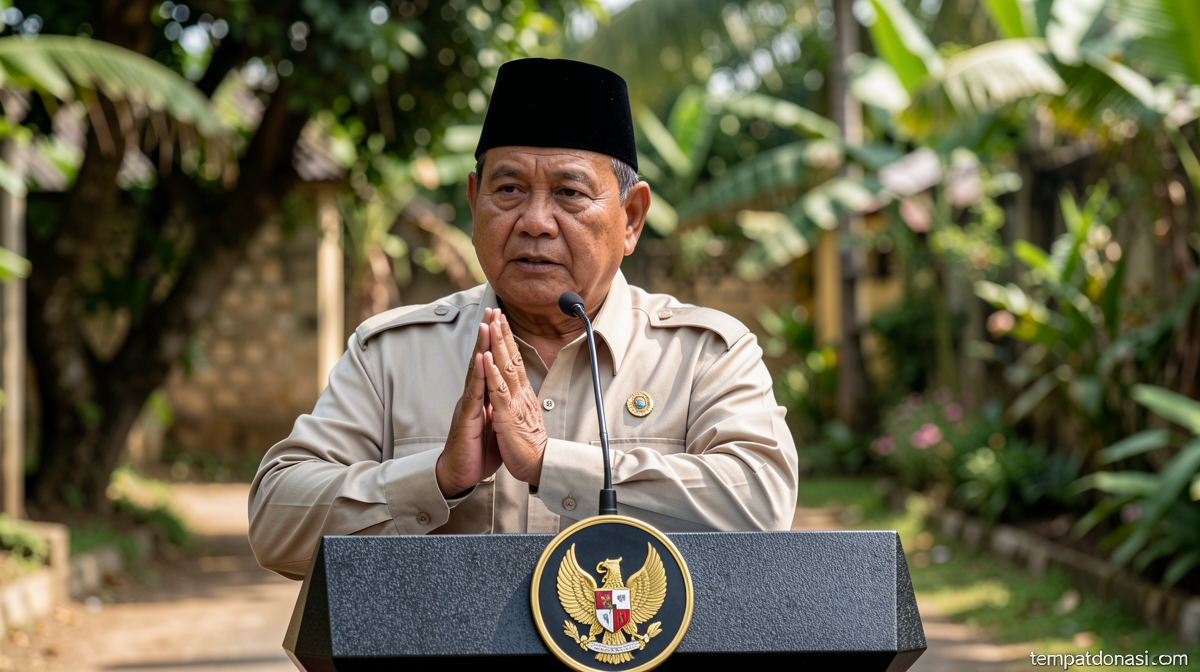
President Prabowo Subianto Champions Indonesia’s B50 Biodiesel Initiative at Karawang Launch
A Strategic Move Toward Energy Independence
Tempatdonasi.com – Indonesia’s President Prabowo Subianto made a significant appearance at the KM 57 Rest Area in Karawang, West Java, on Thursday to officially inaugurate the Mandatory B50 Program. This landmark initiative represents a crucial component of the government’s broader strategy to enhance national energy security and build greater resilience against global market fluctuations. The President arrived at the venue accompanied by several key figures in Indonesia’s energy sector, including Minister of Energy and Mineral Resources Bahlil Lahadalia, Rosan Roeslani who serves as CEO of the Danantara Investment Management Agency, and Simon Aloysius Mantiri, the President Director of state-owned oil company Pertamina.
Upon his arrival at the event location, President Prabowo received a comprehensive briefing regarding the details and implementation timeline of the Mandatory B50 Program. Following this explanation, the President proceeded to the main podium where the official launch ceremony took place. The presence of high-ranking government officials underscored the importance of this policy shift for Indonesia’s future energy landscape.
Key Officials and Regional Support
The launch ceremony was attended by numerous distinguished guests who play vital roles in Indonesia’s economic and political framework. West Java Governor Dedi Mulyadi was among the first to greet the President at the venue, demonstrating strong regional support for the initiative. Coordinating Minister for the Economy Airlangga Hartarto also joined the proceedings, highlighting the cross-ministerial collaboration essential for successful program implementation.
The Mandatory B50 Program forms an integral part of the government’s comprehensive approach to reducing reliance on imported petroleum products. By mandating that diesel fuel contain fifty percent biodiesel content, Indonesia aims to simultaneously boost domestic agricultural production while decreasing its vulnerability to international oil price volatility. This dual benefit strengthens both the energy sector and the broader economy.
Regulatory Framework and Compliance Requirements
The legal foundation for the B50 mandate rests upon two key regulatory instruments. The first is the Regulation of the Minister of Energy and Mineral Resources Number 4 of 2025, which establishes the comprehensive framework for biofuel business operations and utilization. The second is the Decree of the Minister of Energy and Mineral Resources Number 257.K/EK.01/MEM.E/2026, which specifically mandates the fifty percent biodiesel mixing requirement for diesel oil.
Under these regulations, three categories of businesses must comply with established quality standards: biofuel producers, oil fuel distributors, and retail fuel businesses. Non-compliance carries meaningful consequences, with administrative sanctions ranging from formal written warnings to complete revocation of business operating licenses. This enforcement mechanism ensures that all market participants maintain the required standards throughout the transition period.
Implementation Timeline and Testing Results
To facilitate a smooth transition to the new biodiesel standard, the government has established a clear timeline for implementation. Fuel companies have been granted until September 30, 2026, to completely deplete their existing B40 biodiesel inventory before fully transitioning to B50 specifications. During this period, the Ministry of Energy and Mineral Resources will conduct quarterly evaluations of the B50 mandate’s performance and impact.
The government has thoroughly prepared all technical, supply chain, distribution, and regulatory components necessary for successful B50 implementation. Extensive testing has been conducted across six critical diesel engine user sectors: automotive vehicles, agricultural equipment and machinery, heavy mining operations, maritime transportation vessels, power generation facilities, and railway systems. These comprehensive tests involved participation from various ministries and government agencies, private business entities, industry associations, academic institutions, technology providers, and end-user industrial operators.
Preliminary findings from these extensive tests demonstrate that B50 biodiesel performs safely and meets all necessary performance and compatibility requirements for diverse diesel engine applications. While some testing phases remain ongoing, the early results provide strong confidence in the program’s viability across different operational environments.
Economic and Environmental Benefits
The economic projections for Indonesia’s biodiesel programs are particularly encouraging. The existing B40 program is anticipated to generate foreign exchange savings of approximately Rp133.3 trillion by the end of 2025. With the transition to mandatory B50, these savings are projected to grow substantially to around Rp170 trillion by 2026, representing a significant improvement in the nation’s balance of payments position.
Beyond foreign exchange conservation, the B50 program delivers substantial benefits to Indonesia’s palm oil industry. The added value of crude palm oil (CPO) is expected to rise from Rp20.92 trillion to approximately Rp23.49 trillion, providing crucial support to agricultural communities and rural economies. Additionally, the program is projected to create employment opportunities for roughly 2.1 million workers across various sectors of the economy.
The environmental advantages of the B50 mandate are equally significant. By displacing fossil diesel with renewable biodiesel, Indonesia is expected to reduce greenhouse gas emissions by approximately 44.46 million tons of carbon dioxide equivalent by 2026. This contribution aligns with the country’s broader climate commitments and demonstrates a practical approach to sustainable development.
The successful implementation of the Mandatory B50 Program positions Indonesia as a regional leader in renewable energy adoption and provides a model for other developing nations seeking to balance energy security with economic growth and environmental sustainability.