US Fires at Oil Tanker in Strait of Hormuz, Iran: ‘We Never Welcomed War’
American Military Action Targets Oil Vessel in Strategic Waterway as Iran Responds US Fires at Oil Tanker in Strait - On Wednesday evening, a United States
American Military Action Targets Oil Vessel in Strategic Waterway as Iran Responds
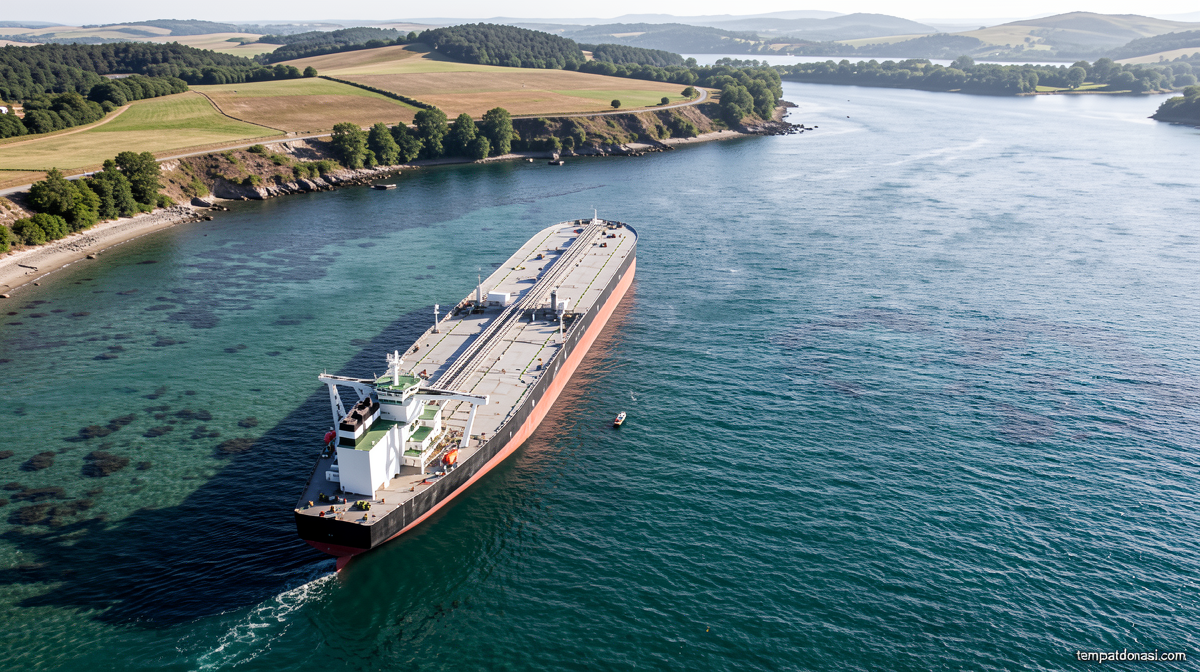
Tempatdonasi.com – On Wednesday evening, a United States aircraft engaged a cargo vessel navigating through the Strait of Hormuz, marking a significant escalation in regional tensions. According to statements released by the US military’s Central Command, the targeted ship was identified as the M/T Belma, an oil tanker registered under the flag of Curacao that was traveling without cargo at the time of the incident.
The vessel had been observed moving through international waters with a course set toward Kharg Island, which serves as one of Iran’s most critical facilities for exporting petroleum products. CENTCOM officials noted that the commercial ship failed to respond adequately to repeated warnings issued during its approach, appearing to challenge what American forces described as an active blockade in the region.
“The commercial vessel ignored multiple warnings as it attempted to violate the US blockade,” CENTCOM stated in a message posted on the social media platform X.
Following the warnings, a US aircraft deployed hellfire missiles that struck the Belma’s smokestack, effectively disabling the vessel and preventing it from continuing its journey toward Iranian territory. This incident represents the third major action taken by American forces since implementing the most recent blockade measures in the Strait of Hormuz. Officials reported that two other commercial vessels had been successfully redirected to alter their courses, while the Belma became the sole non-compliant ship to be disabled.
Coordinated Strikes Against Iranian Capabilities
Earlier in the same day, American military forces executed what they termed “a second wave” of operations targeting Iranian positions. These coordinated attacks focused on military assets that Washington claimed posed threats to maritime traffic moving freely through the strategically vital waterway.
“The strikes are targeting Iranian military capabilities used to threaten vessels freely transiting through the Strait of Hormuz, an international waterway vital to global commerce,” CENTCOM explained on X.
The military command emphasized that these operations were conducted under the direct guidance of the commander in chief, President Donald Trump, who has taken a firm stance on protecting American interests in the region. The afternoon strikes followed a series of daytime operations that had already begun earlier on Wednesday, creating a sustained pattern of military activity.
Iran’s Diplomatic and Military Posture
In response to the escalating situation, Mohammad Qalibaf, who serves as both Iran’s top negotiator and the speaker of parliament, delivered a comprehensive address that was subsequently shared in extended form across social media platforms. The Iranian official articulated a nuanced position that acknowledged the country’s preference for peaceful resolution while emphasizing readiness for potential conflict.
“We have never welcomed war,” Qalibaf declared, “but must always be ready for battle and stand our ground to protect our security and national interests.”
The speech outlined a dual approach that combined diplomatic engagement with military preparedness. Qalibaf stressed that Iran should utilize negotiation mechanisms to advance and secure its national objectives, while simultaneously maintaining the capacity to respond to threats through force if necessary. He characterized the current situation as a “complex war” against what he described as “the greatest material power in the world,” suggesting that a single-dimensional strategy would constitute a “strategic error.”
“Today, our national security lies in maintaining the ‘Iranian arrangements’ on the Strait of Hormuz and allowing commercial ships to pass through this waterway as safely and without harm as possible, so that it will create security for Iran,” Qalibaf stated.
The Iranian official defended the decision to restrict navigation through the Strait during the ongoing conflict, framing it as a demonstration of strength rather than weakness. He referenced Point 5 of the Memorandum of Understanding signed between Iran and the United States, describing this provision as a strategic “lever” for advancing other Iranian priorities within the broader tentative agreement. Qalibaf alleged that American forces were attempting to undermine these Iranian arrangements through coercive measures, asserting that Iran must resist such efforts to preserve its sovereignty and regional influence.
The United States has characterized its recent military actions as defensive responses to Iranian attacks on commercial shipping, presenting a contrasting narrative to Tehran’s position. This divergence in perspectives highlights the complexity of the situation as both nations work to achieve their objectives through a combination of military and diplomatic tools.