Solok Flash Floods: Gradual Relocation Advised for Gov’t Office
Authorities have urged Solok Regency to consider moving its government office complex in Arosuka over time after a destructive flash flood exposed the
Solok Government Complex Faces Long-Term Flood Risk After Arosuka Disaster
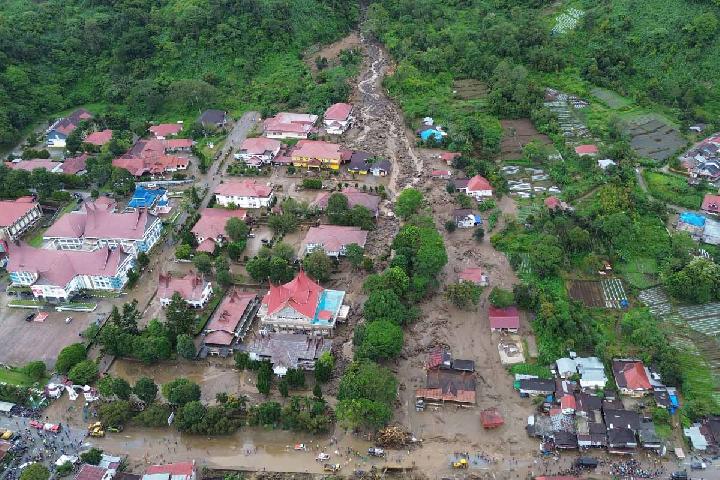
Tempatdonasi.com – Authorities have urged Solok Regency to consider moving its government office complex in Arosuka over time after a destructive flash flood exposed the vulnerability of key facilities in the area. The recommendation follows an emergency geological assessment conducted after flooding struck Arosuka in Gunung Talang District, Solok Regency, West Sumatra, on the evening of September 21, 2026.
The Geological Agency of the Ministry of Energy and Mineral Resources said the relocation should be treated as a medium- and long-term disaster-mitigation measure if further study confirms that the complex sits within a primary flood channel or an area where debris and sediment accumulate.
“The Solok Regency government office complex, in particular, requires a comprehensive evaluation. If the assessment indicates the location is located on a main flow path or material deposition zone, then gradual relocation to a safer location should be a medium- and long-term mitigation priority,” said Geological Agency head Lana Saria.
Valley Location Raises Concern
Arosuka’s government offices, major road links, and public-service buildings lie in a valley connected geomorphologically to the watershed on the western slopes of Mount Talang. This landscape can create serious hazards during intense rain in upstream areas, as water, mud, rocks, and other material may move rapidly through drainage routes toward lower ground.
The agency’s evaluation found that strategic infrastructure within river-basin zones faces a substantial disaster threat when heavy rainfall occurs higher in the catchment. For communities and public institutions, the concern extends beyond a single flood event: repeated exposure can put government operations, emergency access, transport, and essential services at risk.
Officials have called for immediate controls on land use around Arosuka. The proposed restricted zones cover active river basins, valley junctions, and alluvial fan areas. Alluvial fans are landforms created where water slows after leaving a steep valley and deposits sediment; while they can appear suitable for development, they may also be exposed to floodwater and debris flows.
Critical Infrastructure Needs Further Review
The relocation recommendation is not limited to administrative offices. The Geological Agency said safety reviews are also needed for health facilities, bridges, public utility networks, and the principal Solok-Padang road where they remain in exposed locations.
Keeping these systems functional is particularly important after disasters, when residents may need medical assistance, evacuation routes, communications, clean water, and access to supplies. A damaged bridge or blocked road can isolate affected communities, while disruption to utility networks may complicate recovery efforts for days or longer.
“The results of this geological study should be incorporated into the Regional Spatial Plan (RTRW) and the Detailed Spatial Plan (RDTR) to prevent casualty and infrastructure damage risks in the future,” Lana Saria said.
Integrating the findings into regional and detailed spatial planning would give local authorities a formal basis for deciding where future construction, public facilities, and other development should be placed. It could also help identify areas where use should be limited because of continuing flood and debris-flow danger.
Human Impact of the September 21 Flood
The flash flood was triggered by torrential rainfall on September 21. Two people died, while several others were injured. Two victims suffered serious injuries and 12 people sustained minor injuries.
Housing losses were extensive. Eighteen homes suffered severe damage, 11 were moderately damaged, and 41 received minor damage. Four houses were submerged, while three others were left close to collapse.
The flood also disrupted transportation routes and public facilities across the affected area. As of October 2, 542 survivors were still staying in evacuation centers in Solok Regency.
The number of displaced residents highlights the longer recovery challenge facing the region. Restoring damaged homes and infrastructure is essential, but planning decisions made after the emergency can also shape how safely communities are able to live and work in the future.
From Emergency Response to Risk Reduction
Flash floods can develop quickly when intense rainfall sends large volumes of water through steep or confined terrain. In mountainous and valley landscapes, floodwater may carry soil, trees, stones, and other debris, increasing its destructive force. The risks can be particularly high where settlements, roads, or public buildings sit along natural flow paths.
For Solok Regency, the geological assessment points to the need for both immediate protective measures and longer-range planning. Restricting vulnerable land uses can reduce exposure in high-risk zones, while evaluating the location of public infrastructure may help prevent a future disaster from interrupting essential government and community services.
A gradual relocation process, if adopted after a comprehensive review, would require careful planning to maintain public access to government services while safer facilities are developed. The central objective is to ensure that the institutions responsible for responding to emergencies are themselves less exposed to the hazards that can strike the area.
The Arosuka flood has therefore become more than a recovery issue. It has renewed attention on how land-use plans, river-basin conditions, and the placement of public infrastructure can influence the scale of damage when extreme rainfall hits West Sumatra.
Related Reading
Frequently Asked Questions
What is Solok Flash Floods?
Solok Flash Floods is the main topic of this guide. The article explains the context, practical details, and next steps readers should understand.
Why does Solok Flash Floods matter?
Solok Flash Floods matters because readers are looking for a useful answer, not just a short summary. Good content should match search intent and help them decide what to do next.