
Poltracking’s 5 Recommendations for Prabowo-Gibran as Approval Falls
Indonesians are growing increasingly impatient with their government. A new nationwide survey shows overall satisfaction with the Prabowo Subianto–Gibran
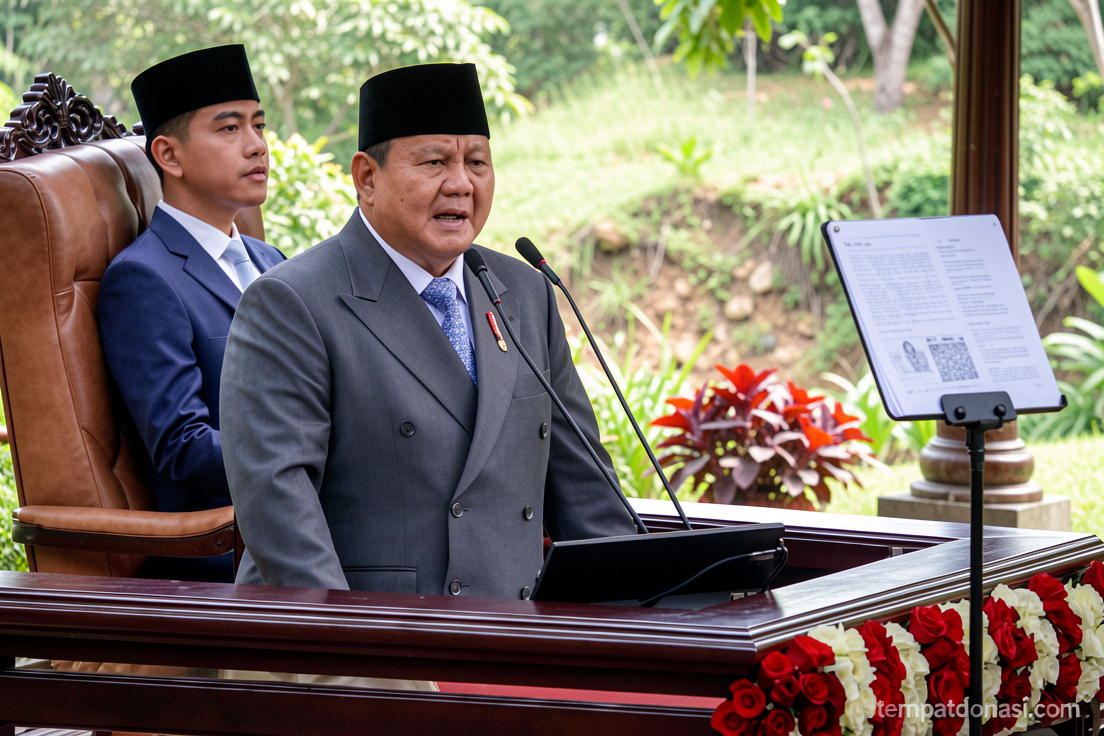
Public Approval Slides Below 60 Percent as Pollsters Urge Prabowo-Gibran Administration to Pivot
Tempatdonasi.com – Indonesians are growing increasingly impatient with their government. A new nationwide survey shows overall satisfaction with the Prabowo Subianto–Gibran Rakabuming Raka administration has dropped to 55.1 percent, marking the steepest single-month plunge in a year-long downward slide that began in late 2025. The figures, released by polling firm Poltracking Indonesia, arrive at a moment when household budgets are strained, basic-goods prices remain elevated, and voters are questioning whether the government’s flagship initiatives are translating into felt benefits at the kitchen-table level.
Senior Poltracking researcher Masduri Amrawi presented the findings on Monday, noting that while the administration’s trust rating still sits at 63.2 percent, the margin for error is narrowing. “The window to correct course is open, but it will not stay open indefinitely,” the data implies. In response, the firm laid out five concrete policy recommendations aimed at arresting the decline before it calcifies into broader political discontent.
The Trajectory: From 78 to 55 in Ten Months
The numbers tell a story of accelerating erosion. In October 2025, shortly after the administration settled into its second year, satisfaction stood at 78.1 percent. By March 2026 it had slipped to 74.1 percent, then 72.2 percent in May. The sharpest break came between July and August, when the figure fell from 58.4 to 55.1 percent — a 13.3-point drop in a single month. That trajectory places the current reading well below the threshold at which most Southeast Asian governments historically begin to face organized opposition pressure.
The August survey polled 1,220 respondents across all 38 provinces of Indonesia through face-to-face interviews conducted between August 14 and 20, 2026. Poltracking employed a stratified multistage random sampling design, yielding a margin of error of roughly 2.9 percentage points at the 95 percent confidence level. The breadth of geographic coverage means the result is not an artifact of urban or coastal bias.
Recommendation One: Shield Household Purchasing Power and Expand Employment
The single most urgent item on Poltracking’s list is economic. Forty-four point three percent of respondents named the high cost of basic necessities — rice, cooking oil, fuel, school supplies — as their primary worry. Meanwhile, 62.5 percent reported that their household spending had risen compared with the same period a year earlier. Satisfaction with the government’s economic management registered at just 41.8 percent, the lowest score among every policy domain surveyed.
For a population of over 280 million, where the median monthly household income remains modest, sustained price pressure on staples functions as a direct tax on survival. The recommendation therefore calls for targeted interventions that protect purchasing power while simultaneously broadening formal-sector employment, reducing the share of households dependent on irregular or informal income.
Recommendation Two: Sharpen Delivery of Priority Programs
Poltracking urged the administration to audit and recalibrate its two marquee social programs: the Free Nutritious Meals (MBG) scheme, which aims to provide school-age children with daily nutrition, and the Red-and-White Village Cooperatives (KDMP), designed to channel state capital into rural micro-enterprise. The firm’s position is not that these programs should be abandoned but that their implementation must be tightened so that tangible benefits reach the intended beneficiaries faster and more uniformly. In provinces where logistics chains are weak, well-designed programs can stall at the last-mile stage, producing the perception of government indifference.
Recommendation Three: Overhaul Governance and Public Communication
Satisfaction varies sharply across policy areas, and Poltracking argues that part of the gap stems from how — or whether — the government communicates its actions. Political affairs and national stability drew a 51.9 percent satisfaction score, while law enforcement and corruption eradication landed at 48.3 percent. The recommendation calls for clearer, more frequent public reporting on program outcomes, budget allocations, and accountability mechanisms, so that citizens can distinguish between policy failure and communication failure.
Recommendation Four: Intensify Law Enforcement and Anti-Corruption Action
The 48.3 percent figure for law enforcement and corruption eradication places the domain below education, social and cultural affairs, healthcare, and defense and security. Poltracking’s fourth recommendation is straightforward: increase the visible tempo of prosecutions, asset recoveries, and institutional reforms that signal corruption is being treated as a systemic threat rather than an administrative inconvenience.
Recommendation Five: Fortify Checks and Balances Within the Executive
The final recommendation addresses the internal architecture of the presidency itself. Poltracking advised that the working relationship between President Prabowo and Vice President Gibran be maintained while being tempered by proportional parliamentary oversight. Masduri framed the point explicitly:
“Prabowo and Gibran’s cohesion, if balanced by proportional parliamentary oversight, could contribute to a dynamic and productive democratic environment.”
The remark carries an implicit warning: executive unity without legislative counterweight risks concentrating decision-making in ways that accelerate policy errors and reduce public confidence in institutional safeguards.
Where Satisfaction Still Holds
Not every domain is in freefall. Education recorded the highest satisfaction at 63.9 percent, followed by social and cultural affairs at 63.7 percent, healthcare at 62.6 percent, and defense and security at 61.6 percent. These figures suggest that Indonesians still credit the state with delivering foundational services, even as they grow skeptical about economic stewardship and anti-corruption follow-through. The challenge for the administration is to prevent the economic and governance deficits from dragging down the domains where trust remains comparatively intact.
With the next legislative elections approaching and the cost-of-living debate dominating local media, the five-point roadmap offered by Poltracking reads less as an academic exercise and more as a deadline notice. The administration’s remaining trust capital — 63.2 percent — is real but finite, and the August data indicate that each subsequent month will test whether corrective action can outpace the erosion curve.
Related Reading
Frequently Asked Questions
What is Poltracking s 5 Recommendations for Prabowo?
Poltracking s 5 Recommendations for Prabowo is the main topic of this guide. The article explains the context, practical details, and next steps readers should understand.
Why does Poltracking s 5 Recommendations for Prabowo matter?
Poltracking s 5 Recommendations for Prabowo matters because readers are looking for a useful answer, not just a short summary. Good content should match search intent and help them decide what to do next.