AHY Speaks on Democratic Party’s Shifting Political Role
At a ceremony held in Jakarta's Yudhoyono Auditorium on Tuesday, September 1, 2026, the Democratic Party gathered to commemorate a quarter-century of its
Democratic Party Marks 25 Years with a Message of Enduring Democratic Commitment
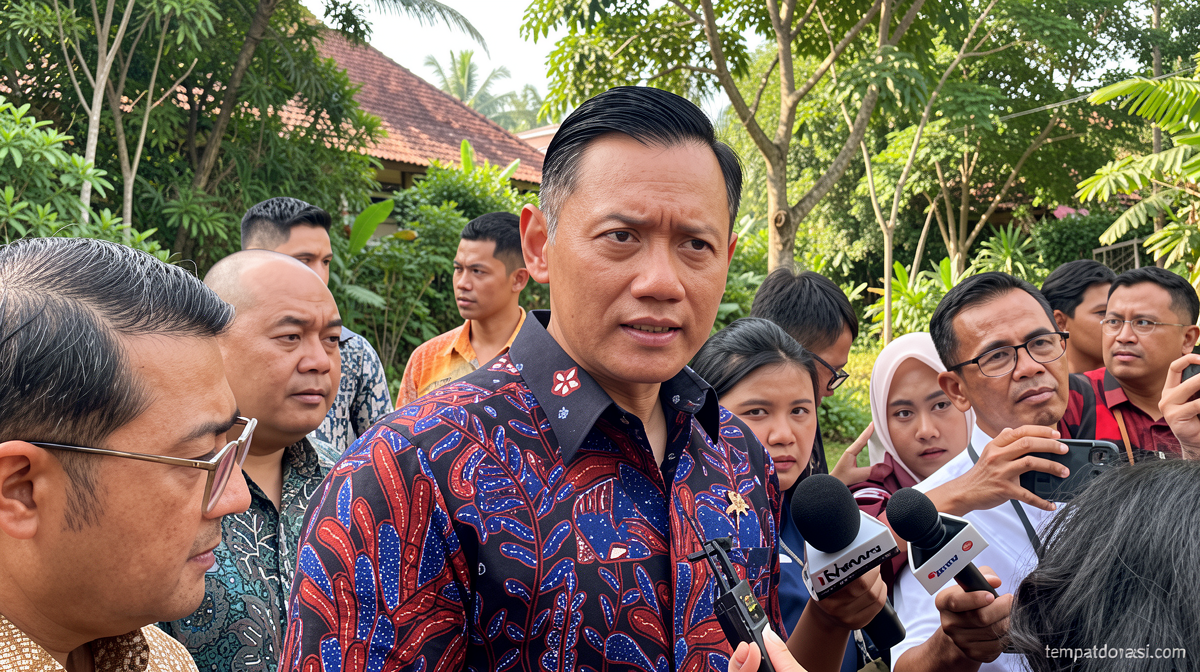
Tempatdonasi.com – At a ceremony held in Jakarta’s Yudhoyono Auditorium on Tuesday, September 1, 2026, the Democratic Party gathered to commemorate a quarter-century of its presence in Indonesian national politics. The occasion carried particular weight because the party’s current General Chairperson, Agus Harimurti Yudhoyono — widely known by his initials AHY and the eldest son of former President Susilo Bambang Yudhoyono — used the platform to frame the organization’s evolving role in government and opposition as a natural feature of Indonesia’s competitive political landscape rather than a departure from its founding principles.
The timing of the remarks was notable. AHY, who simultaneously serves as Coordinating Minister for Infrastructure and Regional Development in President Prabowo Subianto’s cabinet, addressed a membership base that had watched the party traverse three distinct political configurations over the past two decades. First came a decade embedded within the Yudhoyono-era government, followed by years spent on the opposition benches, and now a renewed seat at the executive table under a different president. Each transition, AHY argued, represented a stage of institutional maturation rather than ideological drift.
“The Democratic Party has gone through various phases in its national political journey, from being part of the government for 10 years, sitting outside the government, to once again joining President Prabowo Subianto’s government. These experiences are part of the maturation process for the Democratic Party.”
Those words, delivered in a written statement and circulated publicly on Thursday, September 3, 2026, were designed to reassure cadres and voters alike that the party’s current coalition alignment does not signal a dilution of its democratic mandate. AHY reiterated that the organization rests on three interlocking pillars: the defense of democratic norms, the advancement of economic development, and the pursuit of social justice. None of those pillars, he stressed, had been compromised by the decision to participate in the Prabowo administration.
Democracy as Instrument, Not Destination
A recurring theme in AHY’s anniversary address was the instrumental framing of democratic governance. Rather than treating democracy as a self-contained end, he positioned it as the mechanism through which Indonesia navigates toward material progress and broad-based prosperity. In that reading, the constitutional guarantees of freedom and expression are not abstract ideals but operational tools that must be actively maintained, particularly by carving out meaningful channels for younger citizens to enter public life.
This framing carries practical implications for how the party will approach legislative and regulatory work during its current tenure in government. If democracy is understood as a pathway, then policy choices — from electoral reform to local governance decentralization — are judged by whether they widen or narrow the corridor of civic participation. AHY’s insistence on “constitutionally grounded, responsible freedom” suggests an intention to balance openness with institutional stability, a tension that has defined Indonesian politics since the post-Suharto transition of 1998.
A Call to Adapt Without Dissolving
Looking ahead from the 25-year milestone, AHY urged every cadre within the party apparatus to author what he described as a new chapter. The charge was specific: grow closer to ordinary citizens, stay attuned to the pace of contemporary social and technological change, and increase the party’s tangible contribution to national development. He acknowledged that the external environment — economic structures, generational attitudes, global alignments — would continue to shift, and that the organization must recalibrate its strategies without surrendering its identity.
“So, positions may change. But our commitment to democracy must not change.”
The anniversary event itself, AHY noted, functioned as a structured moment of institutional reflection. Reviewing two and a half decades of electoral performance, internal governance, and public-policy output was framed not as nostalgia but as intelligence-gathering: extracting lessons from past missteps while calibrating responses to challenges yet to come.
Criticism as Operational Input
In a passage that departed from the usual celebratory register of anniversary speeches, AHY stated plainly that the party does not require external validation. What it requires, he said, is constructive criticism — the kind that functions as evaluative data, enabling the organization to diagnose gaps between its stated agenda and the actual needs of the populace. This position implicitly acknowledges that a party embedded in a governing coalition faces a particular accountability deficit: its critics are fewer, its media access is more constrained, and its policy failures are harder to isolate from broader systemic problems.
“Buildings may change, generations may change, but one thing must not change: the Democratic Party must always be with the people.”
The closing line landed against the backdrop of a party that has, over 25 years, fielded candidates in every national election since Indonesia’s first fully competitive post-authoritarian vote in 1999. Its electoral fortunes have fluctuated — from the commanding position of the 2004 and 2009 Yudhoyono presidencies to diminished legislative representation in subsequent cycles — yet the organization has persisted as a recognizable actor in the multi-party system. The 2026 anniversary, set against the backdrop of a party now operating within a ruling coalition, tests whether that persistence translates into continued relevance or risks calcification into a junior partner whose democratic language outpaces its democratic practice.
For Indonesian voters watching the next electoral cycle, the anniversary remarks will be read less as rhetoric than as a roadmap: a signal of where the party intends to position itself between governing responsibility and opposition vigilance, between institutional loyalty and popular accountability. The answer, AHY’s message implies, is that both are necessary, and that the party’s legitimacy rests on its ability to hold them in tension without collapsing into either pole.
Related Reading
Frequently Asked Questions
What is AHY Speaks on Democratic Party s Shifting?
AHY Speaks on Democratic Party s Shifting is the main topic of this guide. The article explains the context, practical details, and next steps readers should understand.
Why does AHY Speaks on Democratic Party s Shifting matter?
AHY Speaks on Democratic Party s Shifting matters because readers are looking for a useful answer, not just a short summary. Good content should match search intent and help them decide what to do next.