Prabowo Quotes Russian Proverb in Vladistovok: What It means
On a September morning in 2026, the halls of the Far Eastern Federal University in Vladivostok hosted the 11th edition of the Eastern Economic Forum, one of
Prabowo Bridges Two Civilizations with an Ancient Russian Maxim at Vladivostok Forum
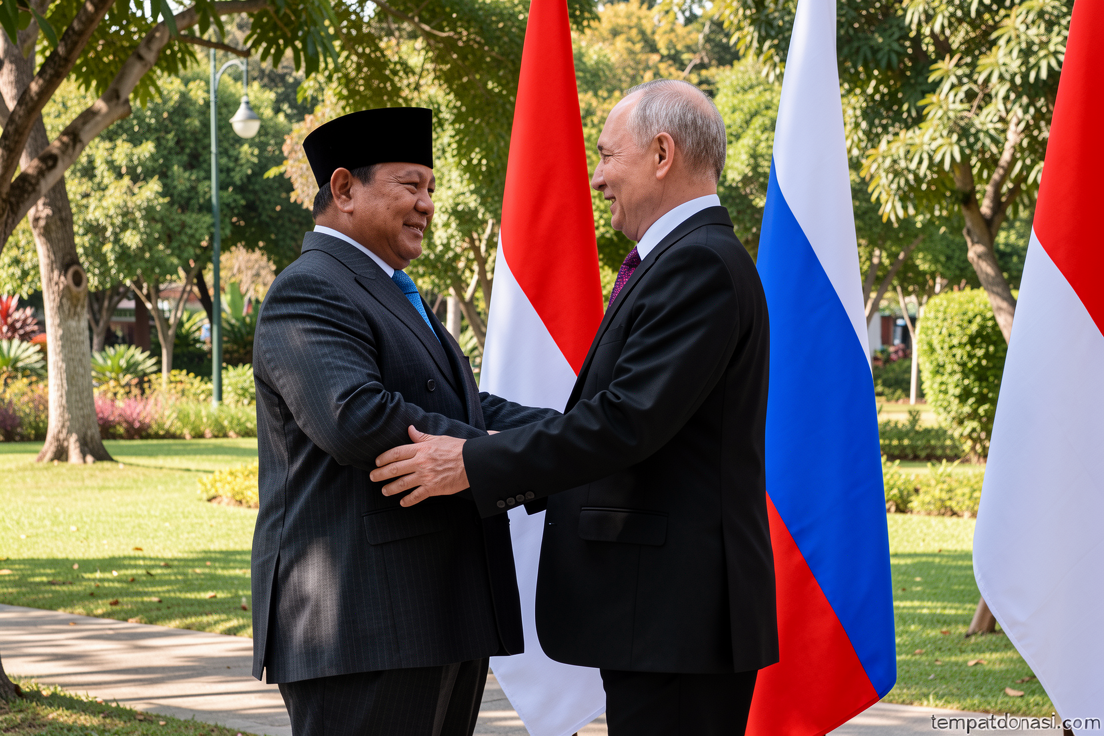
Tempatdonasi.com – On a September morning in 2026, the halls of the Far Eastern Federal University in Vladivostok hosted the 11th edition of the Eastern Economic Forum, one of Russia’s most prominent gatherings for multilateral trade and investment dialogue. Among the dignitaries seated in the audience was Indonesian President Prabowo Subianto, who had traveled to the Russian Far East at the personal invitation of Russian President Vladimir Putin. Prabowo’s presence carried the weight of a principal guest of honor — a distinction reserved for leaders whose participation signals a strategic priority for the host nation.
It was during his address at this high-stakes economic summit that Prabowo reached beyond the usual diplomatic script and invoked a centuries-old Russian saying to frame his vision for bilateral cooperation. The moment, captured on the Presidential Secretariat’s live YouTube broadcast, offered a rare glimpse into how two very different political cultures might find common moral ground.
The Proverb and Its Parallel in Indonesian Thought
Prabowo opened his cultural reference by acknowledging a phrase he said he understood well from Russian folk tradition:
“I understand that the Russian people have a saying: ‘Odin v pole ne voin.’ There can be no victory if we fight alone.”
The proverb — literally translating to “one man in the field is no warrior” — has circulated in Russian oral culture for generations, encoding the idea that individual effort, however capable, cannot substitute for collective action. Prabowo immediately drew a parallel to a cornerstone of Indonesian social philosophy: gotong royong, the principle of mutual aid and shared labor that has shaped village life, disaster response, and communal governance across the archipelago for centuries.
“In Indonesia, we have a similar saying: gotong royong. Any heavy burden becomes lighter if we carry it together.”
By placing these two expressions side by side, Prabowo was not merely offering a rhetorical flourish. He was constructing a shared moral vocabulary — one that transcends the linguistic and geographic distance between Jakarta and Moscow — and using it to justify deeper institutional entanglement between the two states.
From Folk Wisdom to Foreign Policy
The president went on to argue that despite speaking entirely different languages and operating within distinct geopolitical orbits, Indonesia and Russia inherit what he called “the same ancient wisdom from our forefathers.” That shared heritage, in his framing, should translate directly into policy: trade agreements, joint transportation corridors, interoperable payment systems, and co-developed industrial projects must all be oriented toward delivering measurable, tangible gains to ordinary citizens on both sides of the Pacific-Indian Ocean divide.
The emphasis on “tangible benefits” is notable. It signals a departure from purely symbolic diplomacy toward a results-oriented partnership model. For Indonesia, which has long balanced its relationships between Washington, Beijing, and Moscow, such language underscores a pragmatic recalibration: economic interdependence with Russia is being pitched not as ideological alignment but as mutual material uplift.
An Invitation to Equality
Toward the close of his remarks, Prabowo extended what amounted to a formal invitation for Russia to engage Indonesia on terms of full sovereignty and parity. He urged both nations to measure their partnership not by rhetoric but by outcomes:
“Let us work together mutually for the benefit of both our countries. And let us be measured by what our efforts can deliver for our people.”
The phrasing — “equal and sovereign partner” — carries particular resonance given the asymmetry in military and economic scale between the two states. By foregrounding equality, Prabowo was both honoring the diplomatic protocol of the occasion and setting a boundary: cooperation would proceed, but not at the expense of Indonesian autonomy in decision-making.
Context: The Forum and the Broader Landscape
The Eastern Economic Forum, held annually in Vladivostok since 2015, has grown into a platform where Russia courts investment and trade commitments from East Asian, Southeast Asian, and South Asian partners. Its location in the Russian Far East — a region long starved of foreign capital and infrastructure — makes every foreign head of state’s attendance a signal of geopolitical interest. Indonesia’s participation as guest of honor at the 11th edition marks a visible escalation in Jakarta-Moscow engagement beyond the traditional energy-trade lane.
For readers unfamiliar with gotong royong, the concept predates modern Indonesian statehood. Rooted in Javanese and Sundanese agrarian practice, it describes the communal pooling of labor for tasks too large for a single household — building a house, harvesting a rice paddy, or rebuilding after a flood. Indonesian constitutional scholars have cited it as a foundational value informing the nation’s cooperative economic sector. Prabowo’s invocation of the term alongside a Russian proverb thus performed a deliberate act of cultural translation: he was telling his Russian audience that the moral grammar of cooperation they already recognized was, in substance, identical to the moral grammar his own society had practiced for centuries.
The Vladivostok speech, broadcast live to Indonesian audiences on the Presidential Secretariat’s YouTube channel, therefore served a dual audience. Domestically, it reinforced the narrative that Indonesia’s foreign policy is guided by indigenous ethical principles rather than alignment with any single bloc. Internationally, it positioned Jakarta as a bridge-builder between Eurasian and Southeast Asian economic spheres, leveraging shared folk wisdom as a soft-power instrument in a forum where hard-power calculations usually dominate the conversation.
Related Reading
Frequently Asked Questions
What is Prabowo Quotes Russian Proverb in Vladistovok?
Prabowo Quotes Russian Proverb in Vladistovok is the main topic of this guide. The article explains the context, practical details, and next steps readers should understand.
Why does Prabowo Quotes Russian Proverb in Vladistovok matter?
Prabowo Quotes Russian Proverb in Vladistovok matters because readers are looking for a useful answer, not just a short summary. Good content should match search intent and help them decide what to do next.