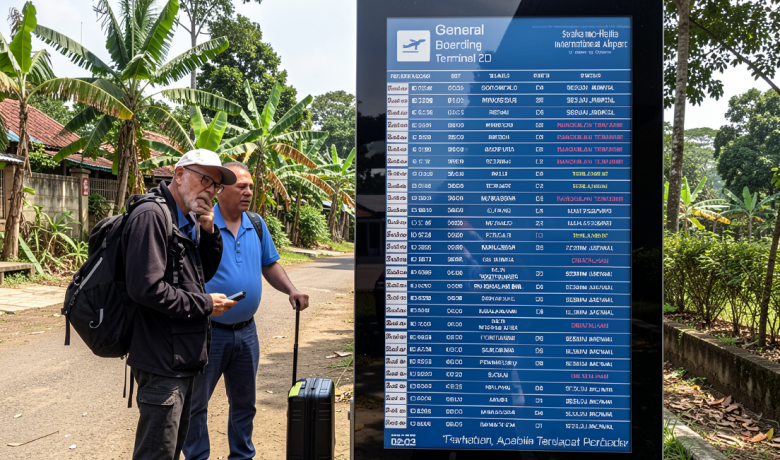
Mount Anak Krakatau Eruption: Airport Closure Affects 22,798 Passengers
A sustained eruption of Mount Anak Krakatau in the Sunda Strait forced Indonesia's busiest international airport into a temporary shutdown on Saturday
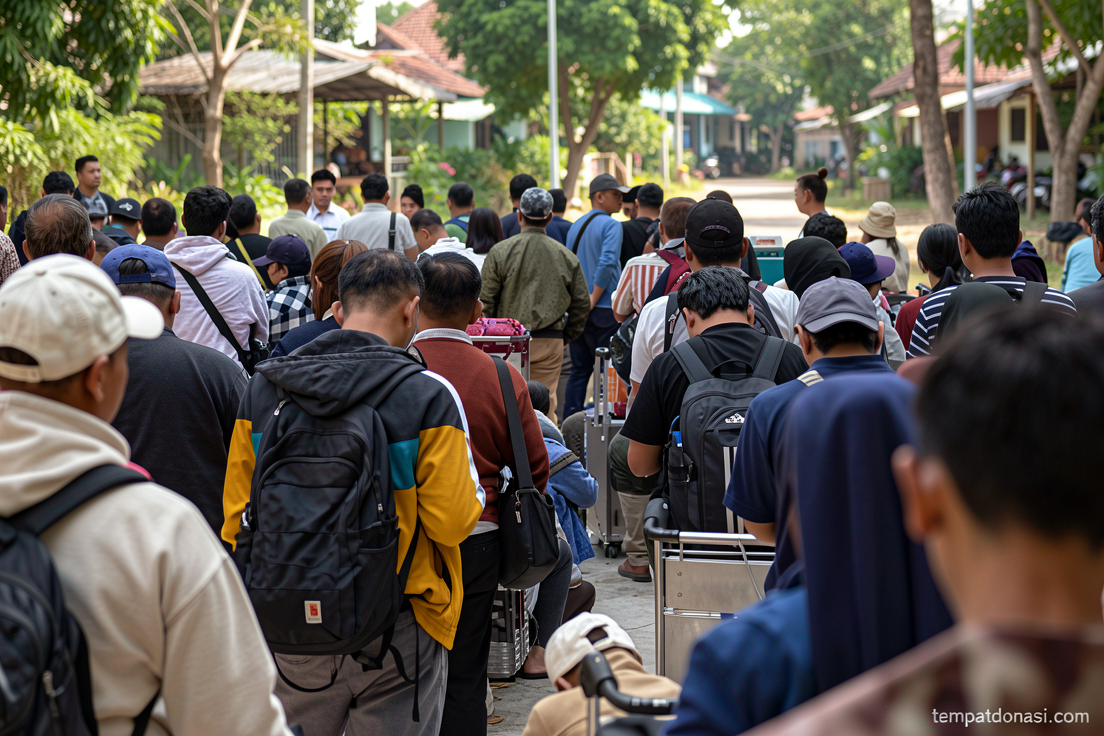
Volcanic Ash From Anak Krakatau Grounds Hundreds of Flights at Jakarta’s Main Gateway
Tempatdonasi.com – A sustained eruption of Mount Anak Krakatau in the Sunda Strait forced Indonesia’s busiest international airport into a temporary shutdown on Saturday morning, September 5, 2026, leaving thousands of travelers stranded and scrambling to reroute their journeys. The closure at Soekarno-Hatta Airport in West Java disrupted 209 scheduled flights and directly impacted 22,798 passengers across both domestic and international networks.
The volcano, which has carried an official “Alert” status since July 2, 2026, produced a continuous eruptive episode that began at 11:07 PM on Friday and persisted until 4:40 AM WIB on Saturday. Visual observations from monitoring stations identified the event as a lava fountaining phenomenon, with incandescent material being ejected well above the crater rim. Surveillance cameras deployed in the vicinity were knocked offline after being struck by ballistic volcanic ejecta.
Airport Closure Extended Beyond Initial Window
Under NOTAM Number A3341/26, Soekarno-Hatta was closed to all aircraft movements from 01:30 to 09:30 WIB. That window represented an extension of an earlier restriction that had originally been scheduled to lift at 05:30 WIB. The decision to prolong the shutdown followed fresh atmospheric readings taken at the airport’s own meteorological facility.
“The latest paper test results from the Soekarno-Hatta Class I Meteorology Station, 06:05 to 06:35 WIB, confirmed indications of volcanic ash dispersion in the Soekarno-Hatta Airport area,” Lukman F. Laisa, Director General of Civil Aviation at the Ministry of Transportation, said in a written statement released Saturday.
International and Domestic Flight Disruptions
The international segment of the disruption was concentrated on a handful of long-haul and regional routes. Across flights to Singapore (SIN), Hong Kong (HKG), Sydney (SYD), Seoul/Incheon (ICN), Doha (DOH), Amsterdam (AMS), and Kuala Lumpur (KUL), operators recorded 16 outright cancellations, 7 delays, and 5 reschedulings. Singapore accounted for the largest share of affected international movements at 11 aircraft operations.
Domestic operations saw a smaller but still significant footprint. Four flights were cancelled and one was diverted, touching routes to Lampung (TKG), Denpasar (DPS), and Surabaya (SUB). The Makassar (UPG) corridor absorbed the heaviest domestic impact, with 16 aircraft movements disrupted—the highest count among any single domestic destination.
Volcanic Activity and Ground-Level Observations
Berton Panjaitan, Acting Head of the BNPB’s Center for Disaster Data, Information, and Communication, described the eruptive column as clearly visible from observation points, though partially veiled by low cloud and fog rated between levels 0 and III on the standard scale. No sustained crater smoke plume was detected during the observation window.
The eruption’s intensity was sufficient to damage fixed monitoring infrastructure. Cameras positioned to track the crater’s activity went dark after fragments of molten rock and ballistic ejecta struck the housings, temporarily blinding the remote-observation network that normally feeds real-time data to eruption-response teams.
Safety Perimeter and Public Guidance
The Center for Volcanology and Geological Hazard Mitigation (PVMBG), operating under the Geological Agency of the Ministry of Energy and Mineral Resources, issued a standing advisory urging the public, tourists, hikers, and visitors to stay clear of a three-kilometer radius around the active crater.
“The Center for Volcanology and Geological Hazard Mitigation (PVMBG), under the Geological Agency of the Ministry of Energy and Mineral Resources, recommends that the public, visitors, tourists, and hikers refrain from approaching Mount Anak Krakatau or engaging in activities within a 3-kilometer radius of the active crater,” Berton said.
Ongoing Monitoring and Traveler Advisories
Lukman emphasized that the Directorate General of Civil Aviation would maintain continuous coordination with airline operators, airport authorities, air navigation service providers, the BMKG (Meteorology, Climatology, and Geophysics Agency), and other stakeholders. Updates would be issued promptly if conditions on the ground shifted materially.
“Safety remains the top priority in every operational decision,” Lukman stated, adding that flight operations would be managed dynamically as conditions evolved.
Prospective passengers were advised to check directly with their carriers before heading to the terminal and to avoid arriving at the airport prematurely while the ash-dispersion picture remained unresolved. For travelers already booked on affected itineraries, airlines were expected to offer rebooking or refund options in line with standard disruption protocols.
Background: Anak Krakatau and the Sunda Strait Corridor
Mount Anak Krakatau sits in the shallow waters of the Sunda Strait, the narrow waterway separating Java from Sumatra and a critical chokepoint for maritime traffic between the Indian and Pacific Oceans. The volcano is the youngest member of the Krakatau volcanic complex, born from the 1883 cataclysmic eruption of its parent, Krakatau. Its proximity to the Jakarta–Bandung air corridor means that even moderate ash emissions can quickly degrade visibility and pose ingestion risks to jet engines, making the airport particularly vulnerable to eruptive events in the strait.
The current “Alert” designation, in place since early July 2026, signals elevated eruptive activity and heightened hazard to nearby communities, shipping lanes, and aviation routes. While the Saturday episode was contained within a roughly five-and-a-half-hour window, the recurrence of fountaining events under Alert conditions underscores the need for sustained atmospheric monitoring at Soekarno-Hatta and along the strait’s shipping channels.
Related Reading
Frequently Asked Questions
What is Mount Anak Krakatau Eruption?
Mount Anak Krakatau Eruption is the main topic of this guide. The article explains the context, practical details, and next steps readers should understand.
Why does Mount Anak Krakatau Eruption matter?
Mount Anak Krakatau Eruption matters because readers are looking for a useful answer, not just a short summary. Good content should match search intent and help them decide what to do next.