
How Seaweed Farming Can Unlock Indonesia’s Blue Economy
Indonesia’s seaweed industry is being positioned as more than a source of raw exports, with a pilot in Sidoarjo, East Java, illustrating how cultivation
Seaweed Farming Offers a Path to Higher-Value Blue Economy Growth in Indonesia
Tempatdonasi.com – Indonesia’s seaweed industry is being positioned as more than a source of raw exports, with a pilot in Sidoarjo, East Java, illustrating how cultivation, processing and cooperative support can generate stronger returns for coastal communities.
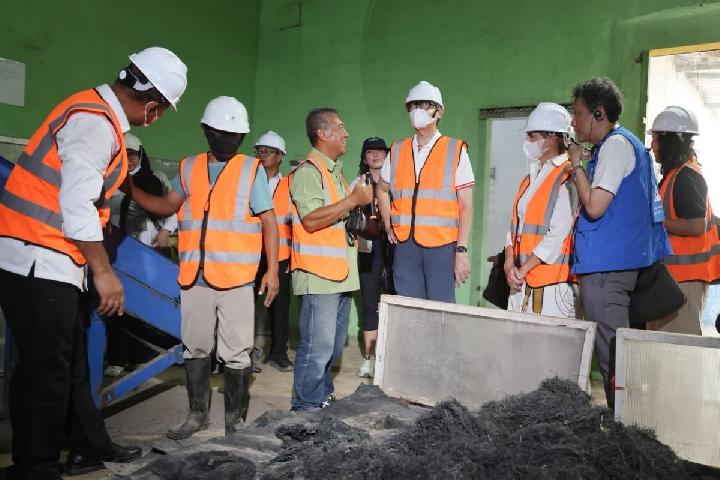
A senior Indonesian government delegation and the United Nations Development Programme visited Sidoarjo on September 17 and 18, 2026, examining practical efforts to expand the value created from seaweed production. The field visit formed part of work connected to the Archipelagic and Island States Forum, an Indonesian government initiative whose Secretariat is hosted and facilitated by UNDP.
The delegation included Deputy Minister of Foreign Affairs Arif Havas Oegroseno; Tb. Haeru Rahayu, Director General for Aquaculture at the Ministry of Marine Affairs and Fisheries; Nani Hendiarti, Deputy for Food Accessibility and Safety at the Coordinating Ministry for Food Affairs; and Dandy Satria Iswara, Deputy for Maritime Resources Coordination at the Ministry of National Development Planning/National Development Planning Agency. Local officials and coastal residents also joined the visit.
From raw material to wider economic value
Indonesia is already one of the world’s leading producers of tropical seaweed, including Gracilaria spp. Its position in international trade is substantial: the country accounted for roughly 69 percent of global seaweed exports in 2025.
Yet export volume alone does not determine how much coastal areas benefit from the industry. A broader blue economy strategy focuses on raising productivity, improving processing capacity, introducing suitable technology, widening market access and attracting investment throughout the supply chain. These measures can help retain more economic value inside Indonesia while supporting employment and incomes in coastal communities.
Seaweed reaches consumers through a series of connected stages. Farmers cultivate and harvest it, after which it must be dried, cleaned, processed, sold and transported to markets. Weakness at any stage can reduce quality, limit prices received by producers or prevent smaller farming groups from reaching larger buyers. The Sidoarjo model is designed to address several of those links at once.
Restoring ponds and strengthening cooperatives
Sidoarjo is an important East Java hub for pond-based cultivation and processing of Gracilaria seaweed. In coastal ponds affected by environmental changes after the 2006 Lapindo mudflow, local communities are cultivating Gracilaria alongside milkfish. The combination has helped bring previously underused ponds back into production while opening economic opportunities for residents.
During the visit, participants went to the Tlocor cultivation area, where they observed harvesting activity, rehabilitated ponds, water-management improvements and on-farm drying. They also visited Koperasi Agar Makmur Sentosa, a cooperative where shared facilities are used for drying, cleaning and pressing seaweed.
Such facilities can improve handling after harvest, an important factor in product quality and commercial value. Shared equipment also allows cooperative members to access processes that may be difficult for individual farmers to finance on their own. Alongside physical infrastructure, the pilot emphasizes stronger cooperative administration and training for farmers.
The initiative is intended to show how rehabilitation of ponds, improved water use, post-harvest equipment and better organization can work together. Its potential importance extends beyond production volumes: a stronger domestic value chain could improve the fisherfolk exchange rate, draw private-sector investment and produce broader benefits for the local ecosystem.
Challenges remain for coastal producers
Indonesia’s marine resources give it considerable scope to develop a more inclusive blue economy, but several obstacles still affect the sector. These include low productivity, inadequate infrastructure, limited technology, skills gaps and difficulties in obtaining financing or reaching markets.
The Sidoarjo pilot does not remove those challenges everywhere, but it provides a working example of how they can be addressed in a specific coastal setting. Its approach places attention on the full route from pond to market rather than treating farming as an isolated activity. That perspective is especially relevant for seaweed growers, whose earnings are shaped by processing, product quality, logistics and the ability to sell consistently as well as by the harvest itself.
“Indonesia has what it takes to become a global leader in the seaweed industry, not only because of the scale of its marine resources, but because of the people, knowledge and innovation that can turn those resources into sustainable economic value,” said Sara Ferrer Olivella, UNDP Resident Representative in Indonesia. “The opportunity is to move from a volume leader to a value leader—mobilizing investment and innovation to create higher-value products, better jobs and higher incomes, while strengthening Indonesia’s position in the global blue economy. What we see in Sidoarjo is one practical example of how this potential can be unlocked.”
The central opportunity is to shift the sector’s emphasis from the quantity of seaweed leaving the country to the value created before it does. More effective processing and stronger market connections could enable seaweed-producing communities to participate more fully in the economic gains associated with Indonesia’s established position in global trade.
For Sidoarjo, the cultivation of Gracilaria and milkfish in rehabilitated ponds shows how coastal livelihoods can adapt to changing environmental conditions. For Indonesia more broadly, the experience demonstrates how existing natural resources, local knowledge, cooperative institutions and targeted investment may be combined to build a seaweed industry with greater social and economic impact.
Related Reading
Frequently Asked Questions
What is How Seaweed Farming Can Unlock Indonesia?
How Seaweed Farming Can Unlock Indonesia is the main topic of this guide. The article explains the context, practical details, and next steps readers should understand.
Why does How Seaweed Farming Can Unlock Indonesia matter?
How Seaweed Farming Can Unlock Indonesia matters because readers are looking for a useful answer, not just a short summary. Good content should match search intent and help them decide what to do next.