
JCI Rebounds From 2.5% Drop After Prabowo Replaces Purbaya
Indonesia’s stock market staged a sharp intraday recovery on Monday, September 14, after President Prabowo Subianto appointed Suahasil Nazara as finance
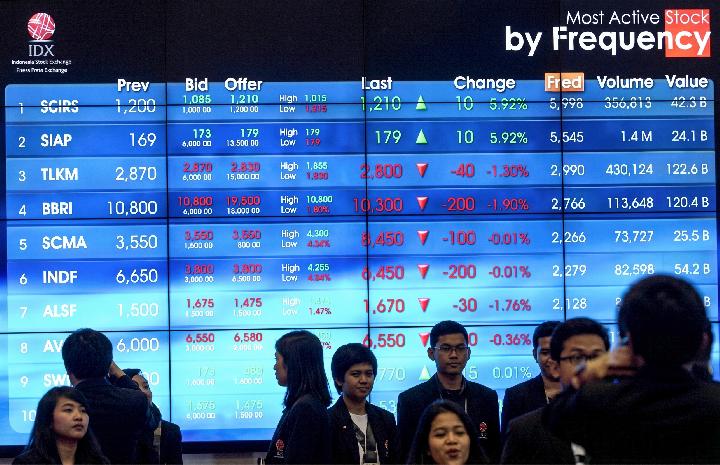
Jakarta Stocks Recover as Investors Assess New Finance Minister
Tempatdonasi.com – Indonesia’s stock market staged a sharp intraday recovery on Monday, September 14, after President Prabowo Subianto appointed Suahasil Nazara as finance minister. The Jakarta Composite Index, or JCI, had at one point dropped 2.5 percent, but regained most of that ground before the close.
The benchmark index ended the day at 6,534.69, down only 0.10 percent. Meanwhile, the LQ45 index, which groups 45 highly liquid and large-capitalization shares listed on the Indonesia Stock Exchange, advanced 9.31 points, or 1.43 percent, to 659.03.
The reversal suggested that market participants viewed Suahasil’s appointment as a potential source of continuity in the government’s fiscal approach. Suahasil has long worked within the Finance Ministry and has served as deputy finance minister since October 25, 2019.
Expectations of Fiscal Continuity
Capital market analyst Elandry Pratama said Suahasil’s experience could help calm concerns over a sudden shift in economic management. His familiarity with state finances, budget processes, and the ministry’s internal structure has become a focal point for investors following the cabinet change.
The market appears to have responded fairly positively because Suahasil Nazara is a figure who is very familiar with fiscal management and the structure of the Finance Ministry, so there is an expectation of policy continuity.
Suahasil replaced Purbaya Yudhi Sadewa in a State Palace ceremony in Jakarta on Monday. The appointment was formalized through Presidential Decree No. 97P of 2026, concerning the dismissal and appointment of the finance minister in the Red and White Cabinet for the rest of the 2024-2029 term. President Prabowo issued the decree on September 14, 2026.
Before becoming finance minister, Suahasil continued as deputy finance minister under Prabowo’s administration after holding the same post during President Joko Widodo’s Indonesia Onward Cabinet. He was reappointed deputy finance minister on October 21, 2024, when the Red and White Cabinet was formed.
For financial markets, the Finance Ministry plays a central role in shaping confidence around public spending, tax policy, borrowing, and the annual state budget. A leadership change can prompt investors to reconsider whether fiscal priorities, deficit management, and coordination with monetary authorities will remain predictable.
More Than a Cabinet Story
Even with the JCI’s late recovery, Elandry cautioned that the day’s movement should not be viewed solely through the lens of the ministerial replacement. International market conditions and commodity-price trends also continued to influence trading sentiment.
The index opened lower and remained below the previous close throughout the first trading session. Selling pressure persisted into the afternoon, although losses narrowed markedly before trading ended. The move from a 2.5 percent decline to a 0.10 percent loss pointed to a considerable improvement in risk appetite during the session.
Going forward, the market will pay closer attention to the government’s fiscal policy direction following the change and whether it can maintain investor confidence.
Investors are likely to focus on Suahasil’s stance toward fiscal discipline, the budget deficit, debt management, and the relationship between fiscal and monetary policy. These areas are closely watched because they shape perceptions of Indonesia’s ability to finance public programs while maintaining market confidence and macroeconomic stability.
A familiar figure at the ministry may reduce uncertainty in the near term, but market participants will still look for policy signals after the transition. Statements on budget priorities and the government’s approach to debt and deficits may carry particular weight in coming months.
Sector Performance and Trading Activity
Sectoral trading was mixed. Three IDX-IC sectors posted gains, while eight ended the day lower. Financial shares recorded the biggest decline among the sectors that fell by a smaller margin, dropping 0.74 percent. Industrial stocks declined 0.40 percent and primary consumer goods slipped 0.02 percent.
Health stocks led the broader retreat, falling 2.15 percent. The energy sector lost 1.49 percent, while infrastructure shares declined 1.45 percent. The contrasting performance across sectors reflected selective buying rather than a broad-based rally.
Among individual stocks, SEMA, LAPD, MPIX, ALKA, and FORU registered the strongest gains. EMAS, ASLI, SRAJ, BYAN, and LUCY were the largest decliners.
Total trading volume reached 34.25 billion shares across 2.101 million transactions. The day’s transaction value amounted to Rp17.98 trillion. Of all traded stocks, 229 rose, 455 fell, and 279 were unchanged.
The breadth of the market showed that weakness remained widespread despite the JCI’s recovery from its deepest losses. At the same time, the rise in the LQ45 indicated relatively firmer demand for a number of major and actively traded stocks.
Regional Markets Deliver Mixed Signals
Asian equity markets also produced an uneven picture. Japan’s Nikkei fell 0.58 percent to 63,641.00, while China’s Shanghai Composite edged down 0.07 percent to 3,885.33. Hong Kong’s Hang Seng gained 0.45 percent, ending at 24,917.60.
South Korea’s Kospi slipped 0.07 percent to 6,684.37. Singapore’s Straits Times Index moved in the opposite direction, rising 0.32 percent to 5,714.37.
For Indonesia, Monday’s trading left a clear message: investors welcomed the prospect of continuity at the Finance Ministry, but confidence will depend on how fiscal policy is carried forward. The market’s recovery limited the immediate damage, yet the JCI’s marginally negative close showed that uncertainty has not disappeared.
Related Reading
Frequently Asked Questions
What is JCI Rebounds From 2 5 Drop?
JCI Rebounds From 2 5 Drop is the main topic of this guide. The article explains the context, practical details, and next steps readers should understand.
Why does JCI Rebounds From 2 5 Drop matter?
JCI Rebounds From 2 5 Drop matters because readers are looking for a useful answer, not just a short summary. Good content should match search intent and help them decide what to do next.