
Anak Krakatau Still in ‘Incubation Phase’: What Does It Mean?
Mount Anak Krakatau, the active volcano in Indonesia’s Sunda Strait, is still considered to be in an “incubation phase” rather than approaching the conditions
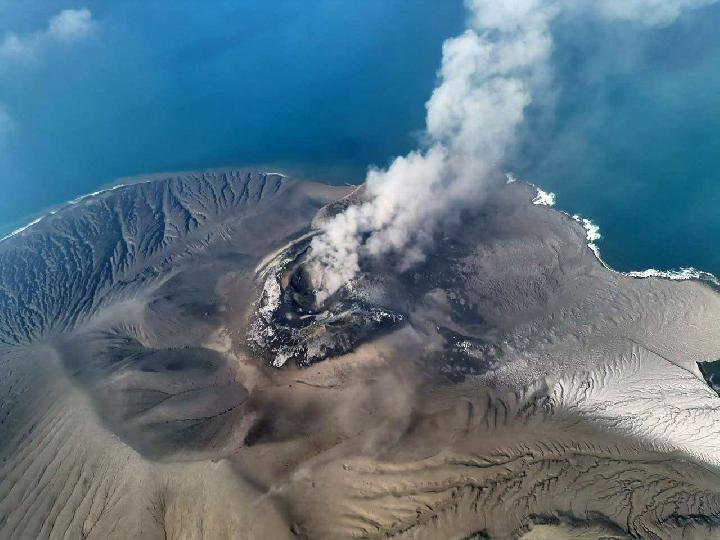
Anak Krakatau Remains in an Early Stage of Its Volcanic Cycle
Tempatdonasi.com – Mount Anak Krakatau, the active volcano in Indonesia’s Sunda Strait, is still considered to be in an “incubation phase” rather than approaching the conditions linked to a massive caldera-forming eruption. The assessment offers important perspective on the volcano’s current development, while also underscoring that it remains an active volcanic system that requires close monitoring.
Aditya Pratama, a researcher at the Geological Disaster Research Center of the National Research and Innovation Agency, or BRIN, said Anak Krakatau has not yet entered the advanced phases associated with an eruption large enough to produce a new caldera.
“At Anak Krakatau, it is estimated to still be in the incubation phase. It is still quite far from reaching the fermentation phase before a caldera-forming eruption,” Aditya said during an online disaster-management discussion in Jakarta on Monday, September 14.
The statement does not mean that volcanic activity at Anak Krakatau should be ignored. Rather, it distinguishes between the volcano’s ongoing hazards and the far larger geological process required for another eruption on the scale of Krakatau’s historic caldera-forming events.
What Scientists Mean by an Incubation Phase
In this framework, a volcano does not move directly from ordinary activity to a giant eruption. Caldera-forming events are understood as developing through several long-term stages. Incubation comes first, followed by maturation and then fermentation before a major eruption can occur.
For readers, the term “incubation” describes an early phase in which the volcanic system has not yet developed the characteristics seen closer to a caldera-forming event. It is a description of the volcano’s longer geological trajectory, not a guarantee that smaller eruptions or other volcanic threats cannot happen.
Anak Krakatau occupies a central place in the volcanic history of the Sunda Strait. It emerged after Krakatau’s catastrophic 1883 eruption and has become the newest stage in a much older volcanic system. Aditya described that history through three broad phases: ancient Krakatau, younger Krakatau, and Anak Krakatau.
The system has experienced repeated cycles of caldera formation over a very long span of time. Aditya referred to evidence of major cycles in the fifth, fourth and sixth centuries, as well as the event in 1883.
“This is at least the second cycle of caldera formation, in the fifth, fourth, sixth centuries, and in 1883,” Aditya said.
Such cycles unfold over timescales much longer than everyday observations of ash emissions, tremors, or visible changes at a volcano. That distinction is essential when interpreting scientific discussion about Anak Krakatau’s present condition.
A Deeper Magma Reservoir
One reason researchers view Anak Krakatau as still distant from a caldera-forming phase involves the location of its magma reservoir. Research published in Frontiers in Earth Science placed the reservoir beneath Anak Krakatau at depths of roughly 7.4 to 26.6 kilometers.
That depth contrasts with findings from the earlier Krakatau systems. Before their destructive eruptions, ancient Krakatau and younger Krakatau had large magma reservoirs at shallower levels beneath the volcanic complex.
The difference matters because the structure, depth and evolution of a magma system help scientists understand how a volcano is changing over time. A deep reservoir beneath Anak Krakatau does not eliminate volcanic risk, but it forms part of the evidence used to assess where the volcano stands in its broader eruptive cycle.
Researchers studied petrographic and geochemical features in more than a dozen rock samples. Their work indicated that the magma beneath Anak Krakatau has continued to evolve and has traits that set it apart from magma associated with earlier phases of the Krakatau system.
Olivine minerals found in samples from Anak Krakatau also point to differences in the chemical makeup of its current magma system. These mineral clues provide scientists with a record of processes occurring beneath the surface, where direct observation is impossible.
Active Does Not Mean a Caldera Eruption Is Near
Public attention around Anak Krakatau often focuses on a straightforward question: is the volcano safe? The scientific answer requires more nuance. Anak Krakatau remains active, and future eruptions remain possible. Its location between Java and Sumatra makes its activity particularly significant for surrounding areas and for disaster preparedness in the Sunda Strait.
At the same time, the current assessment indicates that the path toward a major caldera-forming eruption would require considerable time. An active volcano can still produce hazards without being close to the rare, extreme process of forming a new caldera.
This distinction can help prevent misunderstandings. The absence of signs that a giant eruption is imminent should not be interpreted as an absence of danger. Volcanic monitoring and emergency planning remain necessary because active systems can change, and their risks are not limited to their most dramatic possible events.
A clearer picture of Anak Krakatau’s magma reservoir, mineral composition and long-term cycles can support more informed mitigation efforts. Scientific research gives authorities a stronger basis for understanding the volcano’s development and preparing for hazards connected with future activity.
Anak Krakatau therefore remains a volcano to watch closely: not because current research points to an immediate caldera-forming eruption, but because it is an active part of one of Indonesia’s most historically significant volcanic systems.
Related Reading
Frequently Asked Questions
What is Anak Krakatau Still in Incubation Phase?
Anak Krakatau Still in Incubation Phase is the main topic of this guide. The article explains the context, practical details, and next steps readers should understand.
Why does Anak Krakatau Still in Incubation Phase matter?
Anak Krakatau Still in Incubation Phase matters because readers are looking for a useful answer, not just a short summary. Good content should match search intent and help them decide what to do next.