China Calls for Equal Treatment of All Countries in Global Affairs at UN
Chinese Vice President Han Zheng used his address to the United Nations General Assembly to argue that international decision-making should be based on
China Urges Equal Voice for Nations at UN Assembly
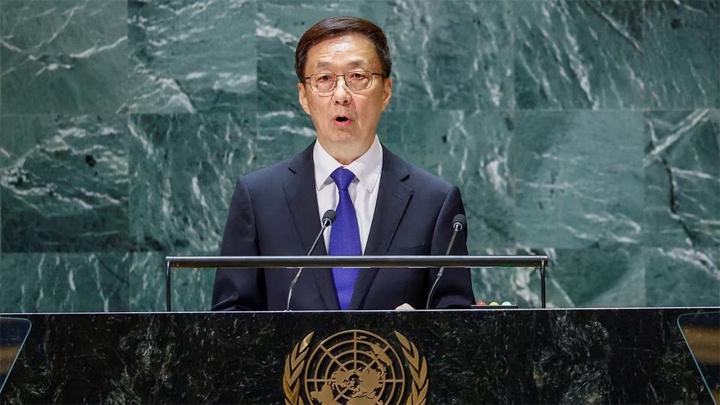
Tempatdonasi.com – Chinese Vice President Han Zheng used his address to the United Nations General Assembly to argue that international decision-making should be based on equality among countries, regardless of their territorial size, population, or economic strength.
Speaking in New York on Saturday, September 26, 2026, Han said global issues cannot be settled fairly without dialogue among nations and respect for legal and ethical principles that apply to everyone. His remarks came during the annual high-level period of the UN General Assembly, when leaders and senior representatives gather to outline national priorities and address major international concerns.
“China believes that all countries, regardless of size, are equal members of the international community, and global affairs must be resolved through consultation and universal respect for international law, justice, and impartiality,” Han said.
Call to Defend the United Nations
Han also called on countries to work together to protect and reinforce the United Nations. The organization remains the central forum where governments can debate international disputes, development questions, security issues, humanitarian crises, and other matters that extend beyond national borders.
His comments emphasized multilateral engagement at a time when governments face overlapping pressures, including geopolitical tensions, uneven development, climate-related challenges, public-health risks, and rapid technological change. For smaller and developing countries in particular, the principle of equal representation is closely tied to whether their concerns can be heard in wider international discussions.
The vice president said cooperation should not be limited by political differences or competing ideological systems. Instead, he urged nations to recognize the choices made by people in other countries and to exchange ideas on governance while seeking common responses to worldwide problems.
“We must cast aside ideological prejudices, respect the development paths and social systems independently chosen by the people of each country, deepen the exchange of governance experiences, and jointly seek solutions to global challenges,” Han said.
Consultation as a Principle of Global Affairs
The appeal for consultation reflects a longstanding argument that no single country should determine the outcome of issues affecting the wider world. In practice, consultation can involve negotiations within UN bodies, diplomatic meetings between governments, regional forums, and joint efforts to develop international agreements.
Such processes can be slow and difficult, especially when countries have sharply different interests. Yet the UN framework is designed to provide a place where those differences can be addressed through diplomacy rather than unilateral action. Han’s address placed particular emphasis on justice, impartiality, and international law as standards that should guide that work.
The idea of sovereign equality is embedded in the UN system. Every member state has a seat in the General Assembly, where broad issues of global concern are discussed. The assembly’s debates do not eliminate differences in influence between major powers and smaller states, but they offer a formal venue for countries to present their positions and build support around shared priorities.
UN General Assembly Session Continues
The 81st session of the UN General Assembly formally began in New York on September 8, 2026. Its opening is followed by a high-level week, a regular feature of the assembly calendar that brings heads of state, government leaders, ministers, and other senior officials to the UN headquarters.
This year’s General Debate was held from September 22 through September 26 and was scheduled to continue on September 28. The debate gives representatives from member states an opportunity to explain how they view current international challenges and what role they believe the UN should play in addressing them.
For readers following the proceedings, speeches during the General Debate are significant not only for their immediate messages but also for the diplomatic priorities they reveal. Calls for equal treatment, adherence to international law, and stronger multilateral institutions point to continuing debate over how global governance should function in a period of heightened competition among nations.
Han’s remarks presented China’s position as one centered on broad consultation and respect for different national development paths. Whether those principles can be translated into shared action will depend on continued engagement among UN member states during the current session and beyond.
Related Reading
Frequently Asked Questions
What is China Calls for Equal Treatment of All?
China Calls for Equal Treatment of All is the main topic of this guide. The article explains the context, practical details, and next steps readers should understand.
Why does China Calls for Equal Treatment of All matter?
China Calls for Equal Treatment of All matters because readers are looking for a useful answer, not just a short summary. Good content should match search intent and help them decide what to do next.