Cyber Troop Maneuvers After Prabowo Speeches
A coordinated burst of social media activity emerged after President Prabowo Subianto drew criticism for describing journalists, researchers, and
Online Networks Amplify Defenses of Prabowo’s “Londo Ireng” Remarks
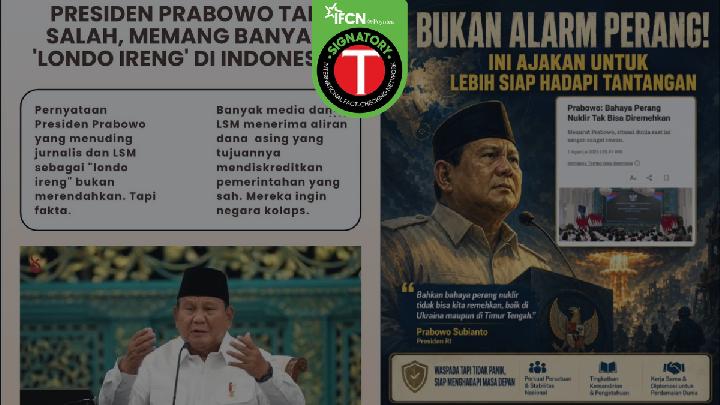
Tempatdonasi.com – A coordinated burst of social media activity emerged after President Prabowo Subianto drew criticism for describing journalists, researchers, and non-governmental organizations as “londo ireng,” a Javanese expression used to describe domestic figures perceived as siding with colonial interests.
The campaign unfolded most visibly on X, where newly created and low-followed accounts circulated messages defending the President’s language and suggesting that foreign financial support was shaping Indonesia’s political climate. The activity followed Prabowo’s July 23, 2026 speech at the Jakarta Convention Center during the National Awakening Party’s anniversary event.
Six journalism and media organizations later condemned the remarks, which placed reporters, analysts, and civil-society institutions in the same category as alleged foreign-aligned actors. Online posts responding to the criticism attempted to recast the phrase as a warning about foreign funding rather than an attack on independent groups.
Posts appeared in rapid succession
One of the accounts involved, @ahmdnizaar98, published a post on July 25 at 2:04 p.m. Western Indonesian Time. It argued that Prabowo’s words should be read as a message about financial flows influencing political developments.
“Implied meaning! ‘Londo ireng’ is a warning for the flow of foreign funding behind political dynamics,”
The account also promoted an article written by Indah Gayatri on Kompasiana. That article questioned the meaning of “londo ireng” and discussed claims concerning foreign funding during political tensions. It named several non-governmental organizations and media outlets, including Tempo, in allegations involving the Open Society Foundations, a philanthropic organization founded by George Soros.
The Kompasiana article was published at 1:37 p.m. WIB, about half an hour before the post from @ahmdnizaar98 appeared. Dozens of other accounts then generated more than 100 posts repeating or reinforcing similar themes. Forty-four accounts also shared the same article.
The timing and repetition created a concentrated wave of content around a single political controversy. In online information campaigns, closely timed posts, shared links, recurring wording, and simultaneous account activity can increase the apparent reach of an argument even when individual accounts have limited audiences.
New accounts played a visible role
@ahmdnizaar98 was created in April 2026 and had only two followers as of September 10, 2026. Despite its small audience, the account regularly circulated government-friendly content, digital posters, and Kompasiana pieces. Its posts praised Prabowo’s leadership, promoted government policies, and criticized civil-society organizations.
Among its recurring narratives was the assertion that Indonesia had already achieved food self-sufficiency. Requests for comment sent to the account had not received a response by September 10. Indah Gayatri, identified as an independent freelance writer, also did not respond to outreach.
An examination of the online activity found a broader network of accounts that appeared to move in step with government clarification efforts after controversial public statements by Prabowo. The accounts’ role was described as helping defend or improve the President’s public image when remarks generated criticism or confusion.
Similar patterns followed other speeches
The “londo ireng” dispute was not the only episode in which comparable online activity appeared. A similar response followed Prabowo’s July 31, 2026 remarks about Iran having nuclear weapons. The President made those comments during a meeting with Indonesian Chamber of Commerce and Industry, or Kadin, business leaders at the State Palace in Jakarta.
Another controversial statement involved the earnings of onion peelers. Prabowo said the pay for peeling onions could reach Rp700,000 per kilogram during the Annual Session of the People’s Consultative Assembly on August 14, 2026. He is also the chief patron of the Gerindra Party.
Such episodes highlight the importance of examining both a political statement and the digital response that follows it. Official explanations, supportive commentary, and coordinated-looking posts can quickly become intertwined, making it harder for readers to distinguish spontaneous public reaction from an organized messaging effort.
More than 1,200 posts tied to the narrative
Social-media monitoring identified 319 accounts that produced 1,210 posts supportive of the government between July 25 and August 11, 2026. About 95 percent of the material appeared on X. The remainder was distributed through Facebook, Instagram, and YouTube.
The hashtag #LondoIreng was the campaign’s central label. The first major push began on July 25, when around 70 accounts issued roughly 120 posts between 2 p.m. and 4 p.m. WIB. Their messages defended Prabowo’s comments and repeated claims about foreign funding.
Further waves followed on July 26 and July 27. Each involved roughly 70 accounts, many of them overlapping with the earlier network. The pattern of activity remained similar: closely spaced posts, shared themes, and repeated efforts to validate the President’s framing of the controversy.
On July 26, 44 accounts simultaneously distributed a link to another Kompasiana article. The synchronized sharing illustrated how a single piece of commentary could be rapidly elevated through multiple accounts acting at nearly the same time.
The data was compiled through social-media monitoring tools, reverse-image searches, and Xpoz. Analysts reviewed publication times, wording, links among accounts, engagement patterns, and profile details. These factors can help reveal whether an online discussion is broad and organic or shaped by networks using coordinated amplification.
The episode underscores the political weight of social platforms in Indonesia, where public disputes can move rapidly from speeches and official events into highly organized online narratives. For audiences, the central challenge is not simply identifying which messages are popular, but understanding how, when, and by whom those messages gained momentum.
Related Reading
Frequently Asked Questions
What is Cyber Troop Maneuvers After Prabowo Speeches?
Cyber Troop Maneuvers After Prabowo Speeches is the main topic of this guide. The article explains the context, practical details, and next steps readers should understand.
Why does Cyber Troop Maneuvers After Prabowo Speeches matter?
Cyber Troop Maneuvers After Prabowo Speeches matters because readers are looking for a useful answer, not just a short summary. Good content should match search intent and help them decide what to do next.