
Fact Check: Did Prabowo, Raffi Ahmad Promote a Rp600,000 Motorcycle Program?
Social media users across Indonesia have been bombarded with short clips promising a motorcycle for a mere Rp600,000 — a price so low it borders on absurdity
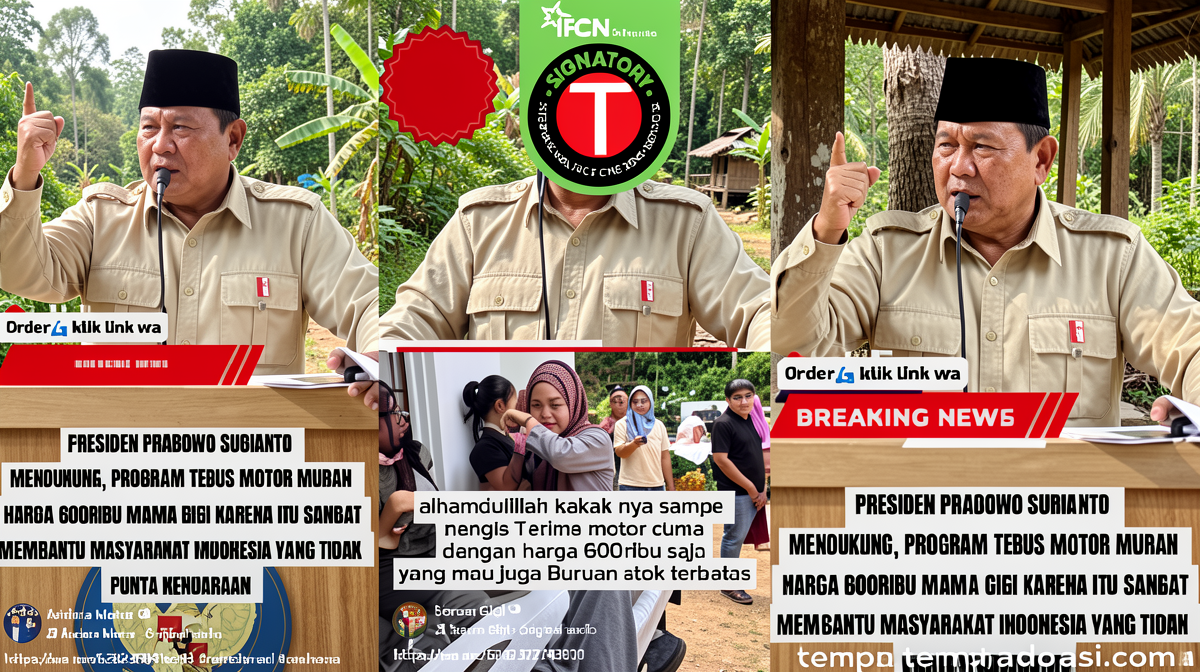
Deepfake Videos Impersonate Prabowo and Raffi Ahmad in Rp600,000 Motorcycle Scam
Tempatdonasi.com – Social media users across Indonesia have been bombarded with short clips promising a motorcycle for a mere Rp600,000 — a price so low it borders on absurdity. The clips, which have spread rapidly through Facebook and WhatsApp, appear to show President Prabowo Subianto personally endorsing the deal as an official community-welfare initiative tied to Raffi Ahmad and Nagita Slavina, the celebrity couple behind the retail brand “Mama Gigi.” A closer examination, however, reveals that every element of the promotion was fabricated or stitched together from unrelated footage using artificial-intelligence tools.
What the Videos Claim
In one widely shared clip posted from the Facebook page “Sorum GIgI,” a figure resembling Prabowo addresses the camera directly, framing the motorcycle offer as a gesture of goodwill toward ordinary citizens.
“This program is here as a gesture of care for the community,” the video’s audio attributes to Prabowo.
A parallel clip, distributed through the Facebook page “Andara Motor,” pairs Raffi Ahmad with comedian Sule. In that version, Raffi allegedly clarifies that the Rp600,000 figure represents the full cash price — no installments, no hidden fees. Both posts embed a WhatsApp link and prompt viewers to tap on-screen buttons, a pattern consistent with click-bait funnels designed to harvest personal data or funnel victims into scripted sales conversations.
Investigation Findings
An independent fact-check investigation confirmed that no such low-price motorcycle program exists at Toko Mama Gigi or any affiliated outlet. The audio tracks featuring Prabowo and Raffi were synthesized or spliced using AI-based deepfake technology. Researchers catalogued at least 133 near-identical video posts — each with slightly different visuals — circulating under four Facebook accounts: Sorum GIgI, Andara Motor, a page styled after Nagita Slavina, and one registered to “Ryzky Saputra.”
None of the four accounts ran paid advertisements on Meta’s platform, meaning the reach was achieved entirely through organic sharing and algorithmic amplification rather than purchased promotion.
Imposter Accounts and Their Origins
The real Nagita Slavina, Raffi Ahmad, and their entertainment company Rans Entertainment all maintain blue-check-verified profiles on Instagram, Threads, and Facebook. Nagita’s verified Facebook page dates to 2015 and currently carries roughly 1.6 million followers. Her verified Instagram handle, @RaffiNagita1717, has been active since the same year. For commercial operations, the couple manages @tokomamagigi on Instagram and @Tokomamagigiofficial on TikTok.
By contrast, the four imposter pages were created in quick succession during July and August 2026. Three of them went live on August 15 and 16, 2026, while the “Ryzky Saputra” account appeared in July 2026. The clustering of creation dates suggests a coordinated operation rather than independent copycats.
Two Tactics, One Goal
The perpetrators relied on two complementary digital techniques. First, they used AI deepfake tools to manipulate original audio and video, inserting fabricated dialogue over existing footage. Second, they repurposed older, legitimate clips by editing them misleadingly or stripping them of their original context.
The “Sorum GIgI” page alone distributed 42 videos featuring various public figures, including Prabowo, Sule, and an automotive entrepreneur. Reverse-image searches traced the Prabowo segment — set against a backdrop bearing the PKB party’s 26th-anniversary logo — to YouTube uploads by national broadcasters such as CNN Indonesia, KOMPASTV, METRO TV, and Liputan6. The underlying footage captured Prabowo attending the PKB anniversary commemoration on July 23, 2026, where he voiced appreciation for the party’s backing of the government’s economic-policy direction. At no point in that event did he mention a motorcycle, let alone one priced at Rp600,000.
AI content-detection analysis by Hive Moderation assigned a 67.4 percent probability that the audio in the manipulated clip was machine-generated.
The Second Prabowo Clip
A separate video showing the president was traced to the Presidential Secretariat’s YouTube live stream dated February 2, 2026, titled “Briefing by the President of the Republic of Indonesia at the 2026 National Coordination Meeting of Central and Regional Governments, Sentul.” During that address, Prabowo discussed how foreign observers characterize Indonesia as “the impossible country” and “the impossible nation,” marveling at how a population spanning countless tribes, ethnic groups, races, major religions, and hundreds of languages manages to cohere within a unitary state.
“They cannot fathom how a country comprising so many tribes, ethnic groups, races, major religions, and hundreds of languages can come together, unite, and pursue its aspirations within the framework of a unitary state,” Prabowo said in the original speech.
The “AI or Not” detection tool returned a 95 percent probability that the recycled video had been produced with AI assistance.
The Raffi Ahmad and Sule Clip
The Andara Motor page, created on August 16, 2026, carried 39 promotional videos all centered on the Rp600,000 motorcycle. A reverse-image search on the clip pairing Raffi Ahmad with Sule matched it exactly to a video posted on the @RaffiNagita1717 TikTok account on April 3, 2026. That original post was simply an invitation to watch the couple’s podcast episode; it contained no motorcycle promotion, no price tag, and no call-to-action button. The scammers had altered the audio layer to insert the solicitation script.
Why This Matters
The episode underscores a growing vulnerability in Indonesia’s digital ecosystem: the combination of celebrity recognition, algorithmic amplification, and increasingly convincing AI synthesis makes it straightforward to manufacture the appearance of state-backed consumer programs. For consumers, the practical takeaway is straightforward — verify any extraordinary offer against the verified social-media handles of the named individuals, check the creation date of the posting account, and treat embedded WhatsApp links or on-screen buttons in unsolicited videos as red flags. For regulators and platform operators, the coordinated timing of account creation and the absence of paid-ads metadata suggest that current verification and transparency tools may need tightening to catch deepfake-driven consumer fraud before it scales.
Related Reading
Frequently Asked Questions
What is Fact Check?
Fact Check is the main topic of this guide. The article explains the context, practical details, and next steps readers should understand.
Why does Fact Check matter?
Fact Check matters because readers are looking for a useful answer, not just a short summary. Good content should match search intent and help them decide what to do next.