M5.1 Aftershock Strikes Near Ruteng in Flores Earthquake Sequence
The tremor that shook communities across Manggarai on the morning of September 8, 2026, was the latest chapter in an extended period of seismic unrest that
Flores Seismic Sequence Continues as M5.1 Aftershock Rattles East Nusa Tenggara Coast
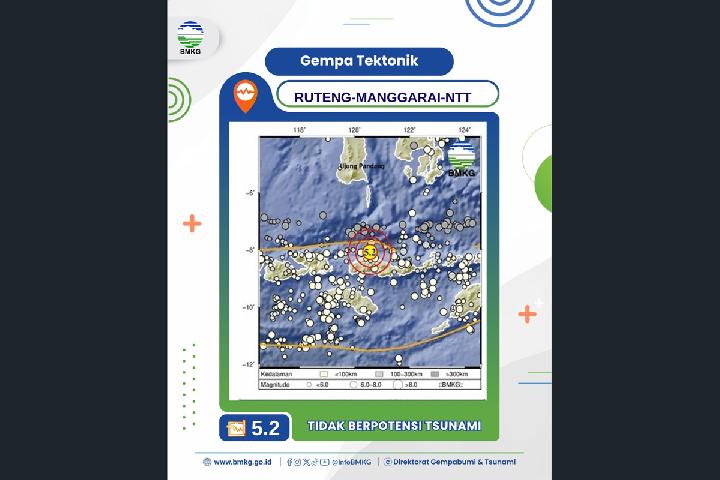
Tempatdonasi.com – The tremor that shook communities across Manggarai on the morning of September 8, 2026, was the latest chapter in an extended period of seismic unrest that has gripped Flores Island since mid-August. At 11:40 a.m. local time, a magnitude 5.1 earthquake registered roughly 57 kilometers offshore to the northeast of Ruteng, the administrative seat of Manggarai Regency in East Nusa Tenggara. Indonesia’s Meteorology, Climatology and Geophysical Agency (BMKG) confirmed the event at a shallow depth of just 10 kilometers, placing it squarely within the brittle upper crust where energy release tends to produce stronger surface shaking than deeper events of comparable magnitude.
No Tsunami Threat, but Sustained Ground Motion
Within minutes of the quake, BMKG Director of Earthquake and Tsunami Wijayanto issued a written statement reassuring the public that the event carried no tsunami hazard.
“Modeling results show that this earthquake has no tsunami potential,” Wijayanto stated.
The absence of a tsunami signal is consistent with the shallow, compressional nature of the rupture. Unlike subduction-interface events that can displace large volumes of seawater, a back-arc thrust at this depth and magnitude typically generates only minor sea-level perturbations, well below the threshold for a warning.
The Flores Back-Arc Thrust at Work
Wijayanto attributed the September 8 shaking to movement along the Flores Back-Arc Thrust, a north-trending fault system that runs parallel to and north of Flores Island. BMKG classified the rupture mechanism as a thrust fault, meaning one block of crust was driven upward and over an adjacent block. This geometry reflects the ongoing compression between the Sunda plate and the Banda Sea microplate, a tectonic interaction that has made the Flores region one of the most seismically active zones in eastern Indonesia.
The Back-Arc Thrust is not a single, continuous fracture but a network of overlapping segments. Activity migrating along different portions of this system over weeks or months is precisely what produces the prolonged aftershock sequences observed since August. Each event, whether magnitude 5 or above, represents a small adjustment in stress distribution following the main rupture.
Shaking Intensity Across Manggarai
BMKG’s estimated shaking-intensity map placed the strongest felt effects at intensity IV on the Modified Mercalli Intensity (MMI) scale. Towns affected at that level included Lamba Leda in East Manggarai, as well as Reok and West Reok in Manggarai Regency. At MMI IV, many occupants of buildings feel the motion indoors, hanging fixtures sway, and lightweight objects may rattle or shift on shelves. It is a level of shaking that startles and disorients but rarely causes structural damage to soundly built structures.
For residents of Manggarai, however, the cumulative effect of thousands of tremors over more than three weeks has eroded a sense of normalcy. Schools, markets, and workplaces in the regency have experienced repeated interruptions, and the psychological toll of sustained seismicity often outlasts the physical hazard itself.
Context: The August 15 Mainshock and Its Aftermath
The September 8 event is formally classified by BMKG as an aftershock within the sequence triggered by the magnitude 7.7 earthquake that struck Flores on August 15, 2026. That mainshock was the largest event in the region in decades and initiated a cascade of smaller quakes that has shown no sign of rapid decay.
As of September 8, BMKG had catalogued 13,591 aftershocks linked to the August sequence. The strongest of those aftershocks reached magnitude 6.2, a size capable of causing localized structural damage in areas with older or poorly reinforced construction. The sheer volume of events—averaging well over 400 per day in the weeks following the mainshock—underscores how thoroughly the crustal stress field around Flores was redistributed by the initial rupture.
Guidance for Residents
Wijayanto urged the public to maintain composure during each tremor and to resist the spread of unverified claims that circulate quickly through social media channels in the hours after a quake. He specifically advised people to inspect their surroundings and steer clear of structures showing visible cracking or other earthquake-induced damage.
“Avoid buildings that have cracks or have been damaged by earthquake shaking,” Wijayanto said.
BMKG indicated it would continue monitoring seismic activity across the Flores–Manggarai corridor and would issue updates whenever new events or changes in the aftershock pattern warranted public notice. For residents, the practical guidance remains straightforward: know your evacuation route, keep a small emergency kit accessible, and treat every tremor—regardless of magnitude—as a prompt to check on family members and inspect the immediate environment for new damage.
The Flores Back-Arc Thrust has produced significant earthquakes in historical records, and the current sequence, while statistically expected following a magnitude 7.7 event, will require sustained vigilance from both the agency and the communities living in its shadow. Until the aftershock rate declines to background levels, the region remains in a state of elevated seismic risk that demands preparedness rather than alarm.
Related Reading
Frequently Asked Questions
What is M5 1 Aftershock Strikes Near Ruteng?
M5 1 Aftershock Strikes Near Ruteng is the main topic of this guide. The article explains the context, practical details, and next steps readers should understand.
Why does M5 1 Aftershock Strikes Near Ruteng matter?
M5 1 Aftershock Strikes Near Ruteng matters because readers are looking for a useful answer, not just a short summary. Good content should match search intent and help them decide what to do next.