Minister: Indonesia Conducts 30-Minute Volcanic Ash Tests at All Airports
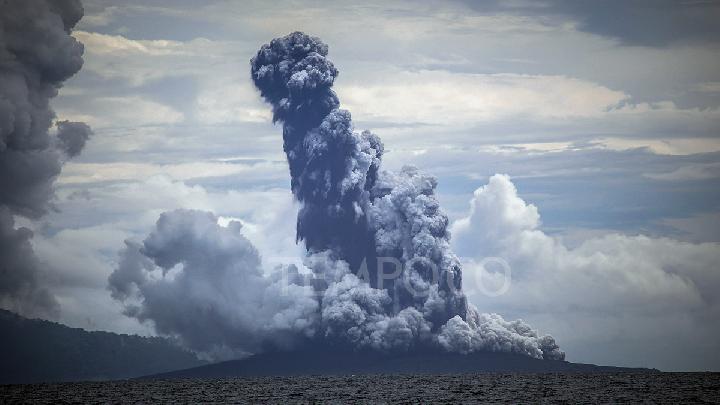
Volcanic ash drifting over the Java Sea has forced Indonesia's aviation authorities into a sustained state of heightened alert. Following renewed eruptive
Indonesia’s Transport Ministry Runs Half-Hourly Ash Checks Across Every Airport After Anak Krakatau Eruption
Tempatdonasi.com – Volcanic ash drifting over the Java Sea has forced Indonesia’s aviation authorities into a sustained state of heightened alert. Following renewed eruptive activity at Mount Anak Krakatau, the Transport Ministry has ordered continuous “paper tests” — instrument-based ash-detection checks — at every airport in the country, not merely those sitting directly beneath the plume. The protocol, confirmed by Transportation Minister Dudy Purwagandhi in Jakarta on Sunday, September 6, 2026, calls for a fresh reading every thirty minutes, a cadence far more aggressive than routine meteorological observation.
The decision came after a government-level review of coordination outcomes with the Meteorology, Climatology, and Geophysics Agency (BMKG) and key aviation partners. Officials assessed the latest atmospheric data available as of Sunday afternoon and concluded that the ash column could not be treated as a localized, short-lived event. The wind pattern, in particular, had begun to change in ways that raised the prospect of a wider dispersal corridor.
Wind Shift Raises the Stakes
Monitoring data compiled through the afternoon showed the prevailing wind at altitude rotating from a westerly to an easterly orientation. At roughly 15,000 feet, the flow was clocking at five knots — modest in speed, but significant in direction. A westerly-to-easterly swing at that level means the ash plume, which had initially been pushed toward the western Java coast, could now be carried eastward over densely trafficked airspace serving Jakarta, Bandung, and the Lampung corridor.
That directional change is precisely what prompted the Transport Ministry to extend its closure order beyond the airports already sitting in the ash path. Rather than wait for ash to arrive at a second set of runways, officials opted for a precautionary, system-wide monitoring posture.
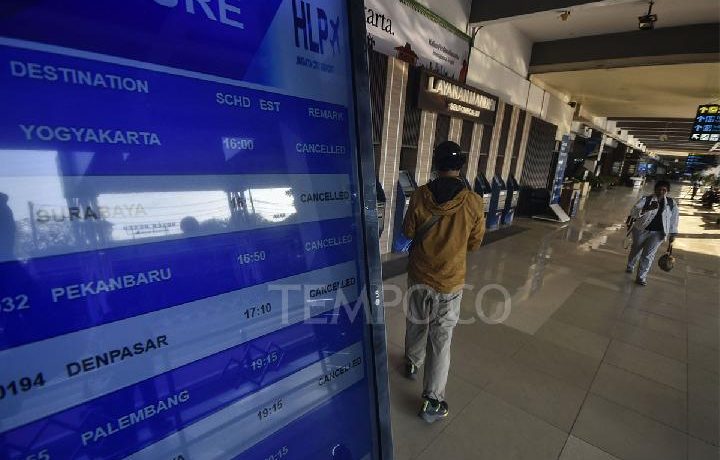
Eight Airports Shut Until Midnight WIB
Under the joint evaluation framework, the ministry ordered temporary closures at eight airports until midnight Western Indonesian Time (WIB). The affected facilities span the western half of Java and the northern Lampung coast:
Soekarno-Hatta International Airport in Tangerang, the country’s primary international gateway; Halim Perdanakusuma Airport in central Jakarta; Radin Inten II Airport in Lampung; Husein Sastranegara Airport in Bandung; Budiarto Airport in Curug, Tangerang; Pondok Cabe Airport in South Tangerang; Taufik Kiemas Airport in West Pesisir, Lampung; and Atung Bungsu Airport in Pagar Alam, South Sumatra.
The closures collectively suspend a substantial share of domestic and international departures and arrivals for the western Java–Lampung corridor, a region that handles millions of passengers annually. Airlines operating into and out of these terminals face cascading schedule disruptions, crew-duty complications, and passenger rebooking demands that typically persist well beyond the official reopening time.
What the “Paper Test” Actually Measures
In aviation meteorology, a “paper test” — sometimes called a paper-strip or filter-paper assay — involves deploying a treated strip of absorbent material at the airport surface. Volcanic ash particles, which are fine silicate fragments, leave a measurable residue that can be quantified within minutes. The technique is inexpensive, rapid, and does not require satellite or radar confirmation, making it ideal for the high-frequency cadence now in effect.
By running the assay every thirty minutes at every terminal, the ministry builds a real-time spatial map of ash concentration. If readings at airports east of the initial plume begin to register positive values, the closure perimeter expands immediately. Conversely, if successive readings trend toward zero, the ministry can lift restrictions airport by airport rather than waiting for a blanket all-clear.
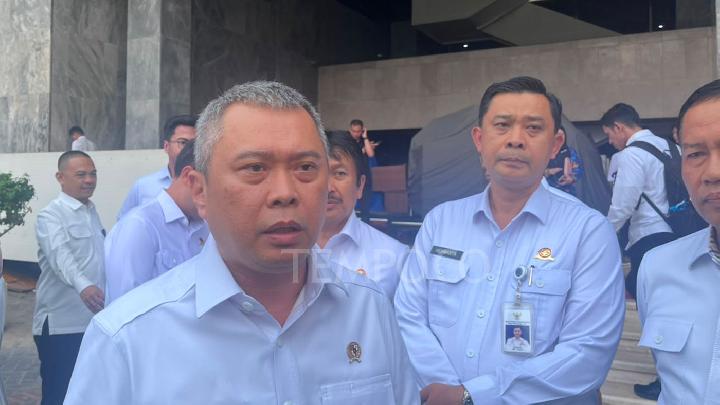
“We are monitoring continuously; every 30 minutes, we conduct paper tests at all airports—not just the eight affected ones, but all airports, particularly those to the east—to anticipate whether the ash spread is widening or subsiding,” Minister Dudy Purwagandhi confirmed in Jakarta on Sunday.
Four-Hourly Consolidated Updates
While the raw assay runs at thirty-minute intervals, the ministry consolidates findings into a formal briefing cycle every four hours. That consolidated product integrates data streams from BMKG, airport operators, AirNav Indonesia (the national air-traffic-services provider), and other relevant agencies. The purpose is to give airlines, ground handlers, and the travelling public a single authoritative picture rather than a patchwork of fragmented alerts.
As of the latest consolidated reading, paper-test results at all eight closed airports still returned positive ash detections. Flight operations therefore could not be resumed, and the closures remained in force through the evening.
“We conduct tests every half-hour. So far, the results at those eight airports remain positive. We will continue to provide updates; Angkasa Pura and the BMKG will keep sharing that information on an ongoing basis,” the Transport Minister said.
Broader Implications and Background
Anak Krakatau, a young volcanic island in the Sunda Strait roughly midway between Java and Sumatra, has a long history of explosive eruptions. Its most recent major event in 2018 produced a partial collapse of the cone and a tsunami that killed more than four hundred people. The volcano sits atop the same subduction zone that powers the broader Sunda Arc, meaning that renewed activity, while not unprecedented, warrants sustained vigilance.
For aviation, volcanic ash poses a particular hazard: particles finer than a grain of sand can melt inside jet-engine combustion chambers, forming a glassy deposit that erodes turbine blades and disrupts ignition. Even concentrations far below what a passenger would notice visually can degrade engine performance over sustained exposure. International guidance from ICAO and national regulators therefore treats any confirmed ash presence at operating altitude as a ground-stop condition until readings clear.
The Transport Ministry has instructed Angkasa Pura (the state airport operator), BMKG, and all downstream stakeholders to maintain continuous public communications so that travellers, freight operators, and connecting carriers receive timely status updates. Every decision to reopen or extend a closure will be anchored to field-monitoring data, with flight safety designated as the overriding criterion.
Officials have stated that the intensive monitoring regime will persist until conditions are formally declared safe across every affected sector. Until that threshold is met, the thirty-minute assay cycle and the four-hourly consolidated briefing will continue without interruption.
Related Reading
Frequently Asked Questions
What is Minister?
Minister is the main topic of this guide. The article explains the context, practical details, and next steps readers should understand.
Why does Minister matter?
Minister matters because readers are looking for a useful answer, not just a short summary. Good content should match search intent and help them decide what to do next.