Riau Leads Indonesia’s High-Integrity Forest Carbon Market
On Tuesday, September 7, the Riau provincial government announced a decisive advance in its GREEN for Riau Initiative, signaling that the province is moving
Riau Positions Itself at the Forefront of Indonesia’s Jurisdictional Carbon Market
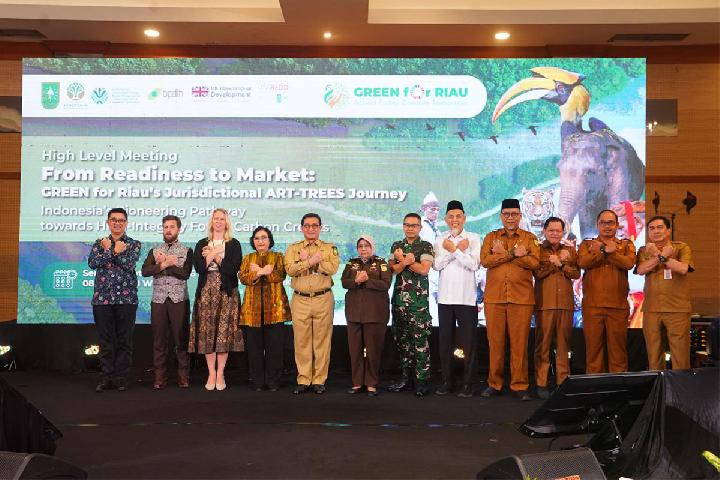
Tempatdonasi.com – On Tuesday, September 7, the Riau provincial government announced a decisive advance in its GREEN for Riau Initiative, signaling that the province is moving toward full implementation of jurisdictional-scale REDD+ under the TREES standard — the REDD+ Environmental Excellence Standard overseen by the Architecture for REDD+ Transactions (ART). The move makes Riau the first Indonesian province to align its forest carbon accounting with this high-integrity international framework, setting a precedent that other regions may follow.
The significance of the step extends beyond a single province. By establishing a transparent, province-wide system for measuring and monetizing forest carbon outcomes, Riau creates a practical template for how Indonesian jurisdictions can participate in global results-based finance without fragmenting their accounting or weakening environmental safeguards.
National Backing and Institutional Readiness
The Ministry of Forestry publicly endorsed the provincial government’s push to strengthen its readiness for jurisdictional REDD+. That endorsement is embedded in a wider national effort to build the technical capacity, institutional safeguards, and governance structures required under Indonesia’s own climate and forestry policies. In practical terms, the ministry’s support validates the province’s trajectory and opens channels for further technical assistance.
“This is a significant milestone for Riau,” said S.F. Hariyanto, Acting Governor of Riau. “Our ambition is to protect forests and peatlands while creating real opportunities for communities. By building one transparent provincial system, we aim to ensure that climate finance rewards measurable results, upholds strong safeguards and the people whose stewardship makes those results possible.”
A Two-Day Gauntlet of Dialogue and Technical Work
Spanning 7–8 September, a tightly linked programme of meetings convened provincial and national officials, United Nations representatives, development partners, diplomats from the UK and Norwegian embassies, local community members, technical specialists, and prospective carbon buyers. The agenda blended high-level policy dialogue with hands-on technical consultations, a field visit to a community-managed site, and a dedicated session with market participants.
The collective purpose of those sessions was to pressure-test the foundations required for jurisdictional REDD+ to function credibly and to unlock access to results-based finance and voluntary carbon market instruments. Specific workstreams included:
Developing a provincial-scale Forest Reference Emission Level (FREL) that remains consistent with Indonesia’s national FREL and its national measurement, reporting, and verification (MRV) architecture. Designing social and environmental safeguards that protect biodiversity, water resources, and community rights. Constructing an equitable benefit-sharing mechanism so that revenue flows reach the people who manage the forests. Drafting clear rules for “nesting” — the process by which smaller project-level or community-level activities are folded into a single jurisdictional accounting framework without double-counting emissions reductions.
A draft Operational Guidance Note outlining Riau’s nesting and accounting architecture was tabled for consultation during the two-day programme, inviting feedback from every stakeholder group present.
“Riau’s efforts to strengthen its readiness for jurisdictional REDD+ are commendable. However, environmental and social integrity must be a foundation from the outset. This includes a reference level and MRV system consistent with the national framework, robust social and environmental safeguards, and clear benefit-sharing,” said Haruni Krisnawati, Expert Staff to the Minister for Climate Change, Ministry of Forestry. “Riau’s experience can offer an important lesson for other provinces developing credible jurisdictional REDD+ as they consider high-integrity pathways in Indonesia.”
Gender, Inclusion, and the Social Dimension
The initiative is explicitly aligned with Indonesia’s National Action Plan on Gender Mainstreaming and Social Inclusion in Climate Change (RAN-GPI), which mandates that climate programmes integrate women’s participation and protect vulnerable groups rather than treating them as passive beneficiaries.
“Women are not only recipients of climate impacts, but also agents and leaders of change. Green development must ensure that women and vulnerable groups are engaged, heard, protected, and able to benefit,” said Arifatul Choiri Fauzi, Minister of Women’s Empowerment and Child Protection of the Republic of Indonesia.
Why Riau Matters: Peat, Fire, and National Climate Targets
Riau holds roughly 4.9 million hectares of peatland alongside extensive tropical forest cover, making the province a critical node in Indonesia’s climate and land-use strategy. The emerging jurisdictional framework is designed to dovetail with the country’s FOLU Net Sink 2030 ambition — the goal of turning forests and other land sectors into net carbon sinks by 2030 — and with ongoing efforts to develop Carbon Economic Value within the forestry sector.
Nesting arrangements are not merely an accounting technicality. Without them, multiple programmes operating at project, community, and jurisdictional scales risk generating overlapping claims on the same emission reductions, undermining market confidence and inflating reported results. A single, auditable provincial framework eliminates that ambiguity.
The Dry-Season Imperative
The readiness milestone lands squarely in Sumatra’s dry season, the period when forest and peatland fires spike and haze blankets the island. Each year, uncontrolled burning of degraded peat releases enormous quantities of CO₂ and short-lived climate forcers, while also degrading air quality across the region. Protecting standing forest and intact peat — shifting from reactive firefighting toward sustained prevention, restoring water governance, rewetting degraded peat ecosystems, and improving land-and-water management — is therefore central to reducing Riau’s long-term fire risk and associated emissions.
“Protecting these forests is about far more than carbon; it is about water, public health, and long-term resilience for the people of Riau,” said Gita Sabharwal, United Nations Resident Coordinator in Indonesia.
For observers watching Indonesia’s carbon market mature, Riau’s next steps will be watched closely. If the province can demonstrate that a single, transparent, safeguard-rich jurisdictional system delivers verified results while distributing benefits equitably, it will have provided the proof-of-concept that other Indonesian provinces — and potentially other tropical jurisdictions — have been waiting for.
Related Reading
Frequently Asked Questions
What is Riau Leads Indonesia s High Integrity?
Riau Leads Indonesia s High Integrity is the main topic of this guide. The article explains the context, practical details, and next steps readers should understand.
Why does Riau Leads Indonesia s High Integrity matter?
Riau Leads Indonesia s High Integrity matters because readers are looking for a useful answer, not just a short summary. Good content should match search intent and help them decide what to do next.