The Palace’s Preferred Slate at the NU Congress
The largest Islamic organization in Indonesia was set to convene its quadrennial leadership election in the East Java town of Jombang during the second week
Presidential Circle Weighs In Before Nahdlatul Ulama’s 35th Congress Opens in Jombang
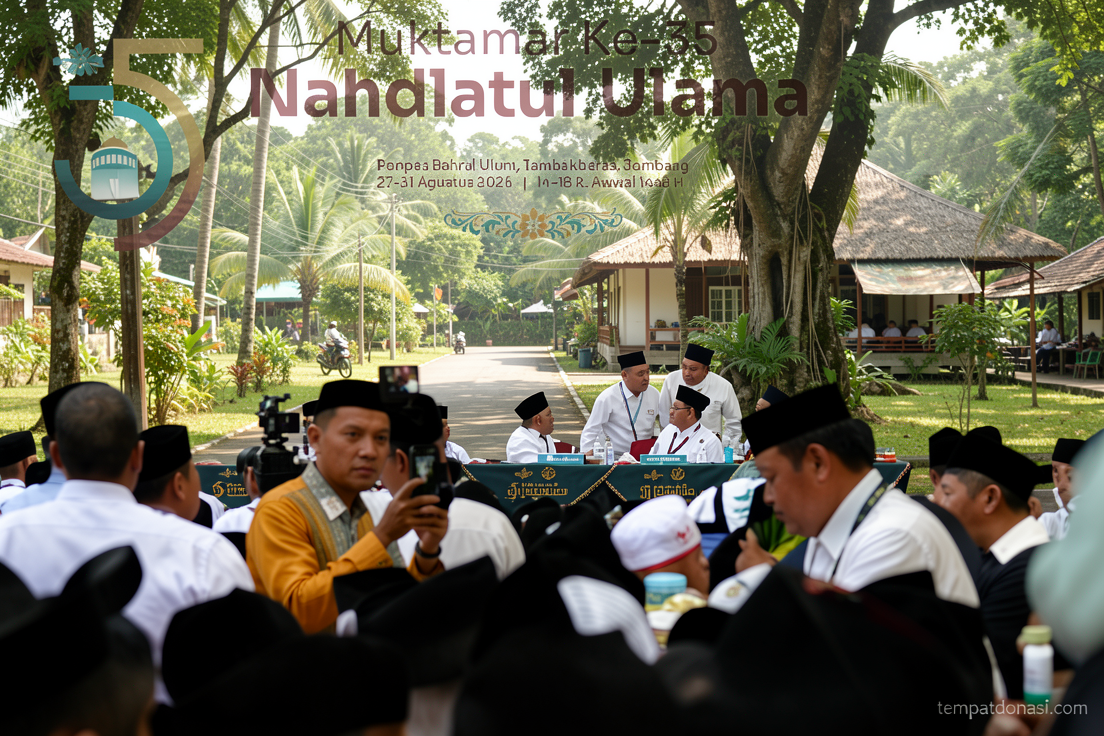
Tempatdonasi.com – The largest Islamic organization in Indonesia was set to convene its quadrennial leadership election in the East Java town of Jombang during the second week of August 2026, but the political currents swirling around the event had already reached the heart of the capital days before delegates were scheduled to arrive. At the Wisma Negara state guest house, located within the grounds of the Presidential Palace complex in Jakarta, a gathering of cabinet ministers, senior party figures, and intelligence officials convened to coordinate positions ahead of what would become the 35th Congress of Nahdlatul Ulama.
A Century-Old Organization at a Crossroads
Nahdlatul Ulama, founded in 1926 as a movement to defend traditionalist (ahl al-sunnah wal-jama’ah) Islamic scholarship against modernist reform currents, has grown into an institution whose membership is estimated in the tens of millions. Its Central Board, known by the abbreviation PBNU, governs the organization’s religious, social, and political direction. Every four years, delegates from regional chapters across the archipelago gather to elect a new chair and leadership council — a process that carries enormous weight in Indonesian public life because NU’s endorsement, or lack thereof, can shape electoral coalitions and shape public opinion on issues ranging from education policy to interfaith relations.
The 35th Congress was to take place at the Bahrul Ulum Islamic Boarding School, commonly called Pesantren Tambakberas, in Jombang. The choice of venue is itself symbolic: Tambakberas is one of the most prestigious pesantren in Java, and hosting the congress there underscores the organization’s roots in classical Islamic pedagogy rather than urban political activism.
Who Sat at the Table
Two sources familiar with the deliberations — one of them a state official stationed at the Palace — confirmed the composition of the pre-congress meeting. Among those present were two ministers who are themselves nahdliyin, meaning they hold formal membership in Nahdlatul Ulama: Saifullah Yusuf and Nusron Wahid. Their dual status as government ministers and NU members made them natural conduits between the executive branch and the organization’s internal politics.
Also in the room were State Secretary Prasetyo Hadi, Deputy Minister of State Secretary Juri Ardiantoro, and Cabinet Secretary Teddy Indra Wijaya, giving the gathering a distinctly administrative character. Religious Affairs Minister Nasaruddin Umar, who at the time was weighing whether to put forward a candidacy for the PBNU chair, attended alongside Muhammad Herindra, head of the National Intelligence Agency (Badan Intelijen Negara). The presence of the intelligence chief at a meeting about a religious organization’s internal election mechanism drew particular attention, though no official explanation was offered for his inclusion.
From the legislative and party side, Deputy Speaker of the House of Representatives Sufmi Dasco Ahmad was present, along with several politicians affiliated with the Gerindra Party, which anchors President Prabowo Subianto’s governing coalition. The mix of cabinet secretaries, ministers, a deputy speaker, and party loyalists signaled that the congress was being treated not merely as a religious event but as a matter of state-level political coordination.
What Was Discussed
According to one participant, a central topic of the deliberations was the mechanism by which the PBNU leadership would be elected at the congress. NU’s internal bylaws prescribe procedures for delegate voting, quorum requirements, and the role of regional chapters in nominating candidates, but the precise application of those rules in any given cycle can become contested. Questions over whether certain candidates meet eligibility criteria, how delegates from smaller chapters are weighted, and whether the congress should adopt a single-round or multi-round voting format have historically generated friction within the organization.
The fact that the discussion took place inside the Presidential Palace complex, with cabinet secretaries and an intelligence chief in attendance, raised questions among NU observers about the degree to which the executive branch wished to influence, or at least anticipate, the outcome of an organization that has traditionally maintained institutional independence from any single political party.
Why the Timing Matters
The congress fell in the second week of August 2026, a period when the Prabowo administration was navigating its first full year in office and seeking to consolidate relationships with civil-society institutions that command mass followings. Nahdlatul Ulama’s potential endorsement of government policies — or its willingness to voice criticism — carries electoral and reputational consequences that no other single organization in Indonesia can match. Ministers who are themselves NU members occupy a delicate position: they must represent the executive’s agenda in cabinet while remaining accountable to the organization’s internal governance structures.
The gathering at Wisma Negara, therefore, can be read as an attempt to align the government’s expectations with the procedural realities of the congress before delegates began arriving in Jombang. Whether that alignment succeeded, or whether the congress ultimately produced a leadership slate that diverged from the preferences of the Red and White Cabinet, remained to be seen once the voting concluded at Pesantren Tambakberas.
The mechanism for electing the PBNU leadership was among the topics discussed at the pre-congress meeting, according to one participant.
For millions of Indonesians who identify with Nahdlatul Ulama’s traditionalist scholarship, the congress is ultimately about the continuity of a religious tradition that has shaped Javanese Muslim life for nearly a century. The political machinery that gathered in Jakarta before the delegates arrived in Jombang was, by contrast, a reminder that in Indonesia’s pluralistic landscape, no religious institution operates entirely outside the gravitational pull of state power.
Related Reading
Frequently Asked Questions
What is The Palace s Preferred Slate at?
The Palace s Preferred Slate at is the main topic of this guide. The article explains the context, practical details, and next steps readers should understand.
Why does The Palace s Preferred Slate at matter?
The Palace s Preferred Slate at matters because readers are looking for a useful answer, not just a short summary. Good content should match search intent and help them decide what to do next.