Three False Gharial Hatchlings Rescued After Hatching in West Kalimantan
Three baby false gharials — members of one of Southeast Asia's most threatened freshwater crocodilian species — were pulled from the waters near a small
Endangered False Gharial Hatchlings Found Alive in West Kalimantan Fishing Village
Tempatdonasi.com – Three baby false gharials — members of one of Southeast Asia’s most threatened freshwater crocodilian species — were pulled from the waters near a small fishing hamlet in West Kalimantan after hatching within sight of human dwellings. The rescue, carried out by Indonesia’s Ministry of Marine Affairs and Fisheries, marks a rare confirmation that the Mempawah Hulu River basin still harbors a functioning reproductive population of Tomistoma schlegelii, a species that has all but vanished from much of its former range across Borneo and Sumatra.
A Rare Sighting in an Unlikely Location
The hatchlings were discovered in Teredu Hamlet, Mempawah District, a community where residents had long known crocodiles as occasional visitors to the river but had never witnessed eggs actually hatching so close to their homes. Local Dayak Kanayatn/Ahe people refer to the species by the name “Baringayong,” a term that carries generations of ecological knowledge about the animal’s habits along the waterway.
What made this event particularly significant was its geography. Prior documented records of false gharials in West Kalimantan had been concentrated in the more remote Kapuas Hulu and Ketapang districts, areas characterized by dense peat-swamp forests and limited human settlement. Finding a clutch of eggs — and then live young — in Mempawah, a district with considerably higher population density and agricultural activity, suggests the species’ distribution may extend further than conservation planners had assumed.
The Rescue Operation
When residents reported that crocodile eggs had cracked open near the settlement and that the tiny animals appeared vulnerable to capture by traffickers, the Pontianak Marine Management Center dispatched its quick-response team to the site. The team’s mandate was threefold: secure the hatchlings, collect biological and environmental evidence, and interview villagers to reconstruct the timeline of the hatching event.
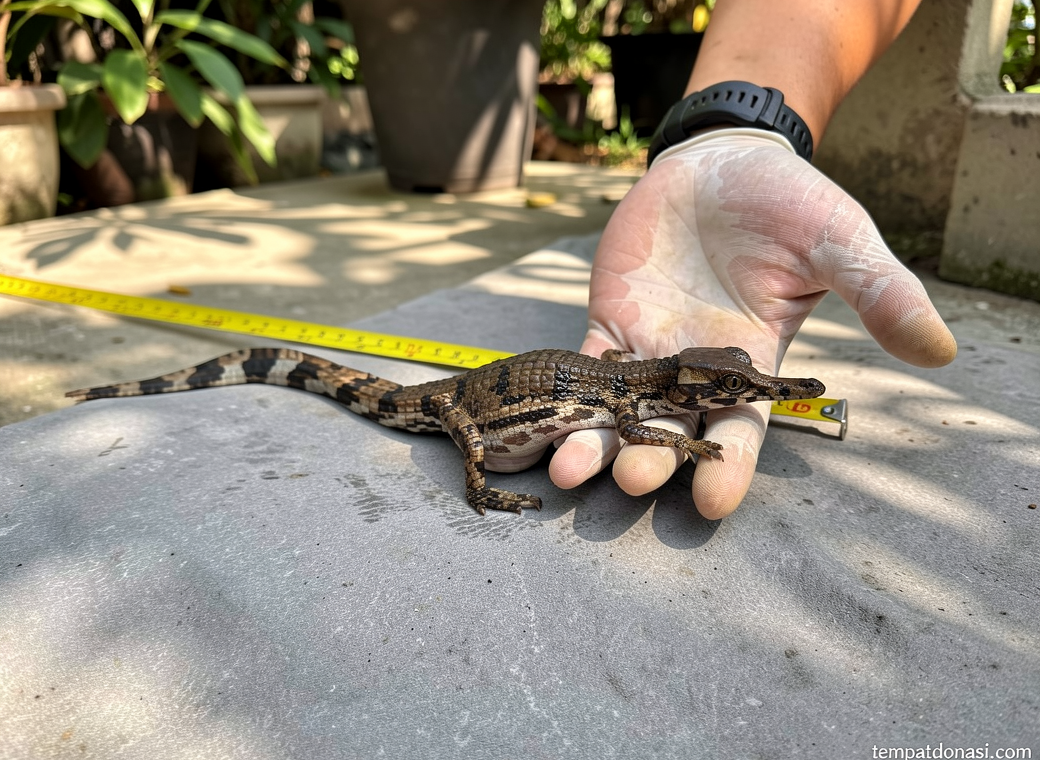
Each of the three young crocodiles measured roughly 33 centimeters (about 13 inches) from snout to tail tip — a size consistent with freshly emerged hatchlings of the species. A specialist veterinarian performed an initial remote clinical assessment and judged the animals to be in relatively good overall condition. One complication, however, was noted: residual yolk-sac tissue remained attached to the abdomens of the hatchlings. Left unaddressed, such remnants can become entry points for bacterial infection, so the young crocodiles were moved immediately into intensive care.
They are now housed in an incubator at the center’s temporary shelter, where staff will monitor their recovery until their physical condition stabilizes and the yolk-sac tissue has fully resorbed. Only after that milestone will any decision about long-term management or eventual release be considered.
What the Discovery Means for Conservation Planning
Syarief Iwan Taruna Alkadrie, head of the Pontianak Marine Management Center, framed the find as a critical data point for mapping where false gharials still breed in West Kalimantan. In an official statement issued on Monday, he stressed that the Mempawah Hulu River ecosystem demonstrably supports both the presence and the reproductive cycle of the species.
“The discovery provides an important data point for mapping the distribution of false gharials in West Kalimantan, while also offering insights into the current condition of their habitat.”
Alkadrie cautioned, however, that the long-term viability of such habitats depends on monitoring a suite of environmental pressures: the ongoing degradation and fragmentation of peat swamps that supply nesting and foraging grounds, shifts in seasonal river flow regimes driven by upstream land-use change, and fluctuations in the abundance of natural prey such as small fish and aquatic invertebrates. Without sustained observation, conservation managers risk designing protections around assumptions that no longer match reality on the ground.
Background on the Species and Its Threats
The false gharial, sometimes called the long-snouted crocodile, is distinguished from its close relative the true gharial by a broader, more robust snout and a preference for brackish and freshwater habitats rather than strictly riverine ones. Across its range in western Borneo, southern Sumatra, and the Malay Peninsula, the species has been pushed into steep decline by habitat conversion, accidental bycatch in fishing gear, and targeted collection for the pet trade.
On the IUCN Red List of Threatened Species, Tomistoma schlegelii carries the classification Endangered, reflecting a population that has contracted markedly over recent decades. It also appears in Appendix I of CITES — the Convention on International Trade in Endangered Species of Wild Fauna and Flora — meaning that international commercial trade in the species is effectively prohibited and that any cross-border movement requires permits backed by scientific justification.
The ministry has publicly urged residents and visitors to West Kalimantan not to capture, keep, or trade false gharials of any age. In a district where small-scale fishing remains a primary livelihood and where the economic value of an exotic reptile can tempt informal collectors, that message carries practical weight: a single hatchling removed from the river can represent the loss of an entire reproductive investment by a female that spent weeks guarding her nest.
Looking Ahead
The survival of the three hatchlings now in care will be watched closely by conservation biologists in the region. If they recover fully, their eventual fate — whether release back into the Mempawah Hulu River or transfer to a managed breeding program — will inform broader strategies for re-establishing viable populations in areas where the species has already disappeared. Either way, the episode underscores a simple but urgent point: West Kalimantan’s rivers still hold the raw material for recovery, but only if the habitats that produced these three tiny crocodiles are kept intact, connected, and free from the pressures that drove the species to the edge of extinction in the first place.
Related Reading
Frequently Asked Questions
What is Three False Gharial Hatchlings Rescued After?
Three False Gharial Hatchlings Rescued After is the main topic of this guide. The article explains the context, practical details, and next steps readers should understand.
Why does Three False Gharial Hatchlings Rescued After matter?
Three False Gharial Hatchlings Rescued After matters because readers are looking for a useful answer, not just a short summary. Good content should match search intent and help them decide what to do next.