What to Know About the LRT City Residential Project
Homebuyers across Jakarta's eastern corridor have been left waiting for months — sometimes years — for keys to apartments that were promised alongside the
Government Steps In as LRT City Housing Delays Leave Thousands of Buyers in Limbo
Tempatdonasi.com – Homebuyers across Jakarta’s eastern corridor have been left waiting for months — sometimes years — for keys to apartments that were promised alongside the region’s expanding rail network. Now the state has moved to intervene directly. Minister of Housing and Settlements Maruarar Sirait confirmed that his ministry has formally escalated the stalled LRT City apartment development to two oversight bodies: the Supreme Audit Agency (BPK) and the Financial and Development Supervisory Board (BPKP). The announcement signals that the government views the situation not merely as a commercial dispute but as a matter of consumer protection requiring institutional scrutiny.
The troubled development is operated by PT Adhi Commuter Properti Tbk (ADCP), a subsidiary of state-owned construction giant PT Adhi Karya (Persero) Tbk. Completion timelines have slipped repeatedly, leaving buyers without a reliable handover date and eroding confidence in one of Indonesia’s largest transit-oriented housing programs.
What LRT City Actually Is
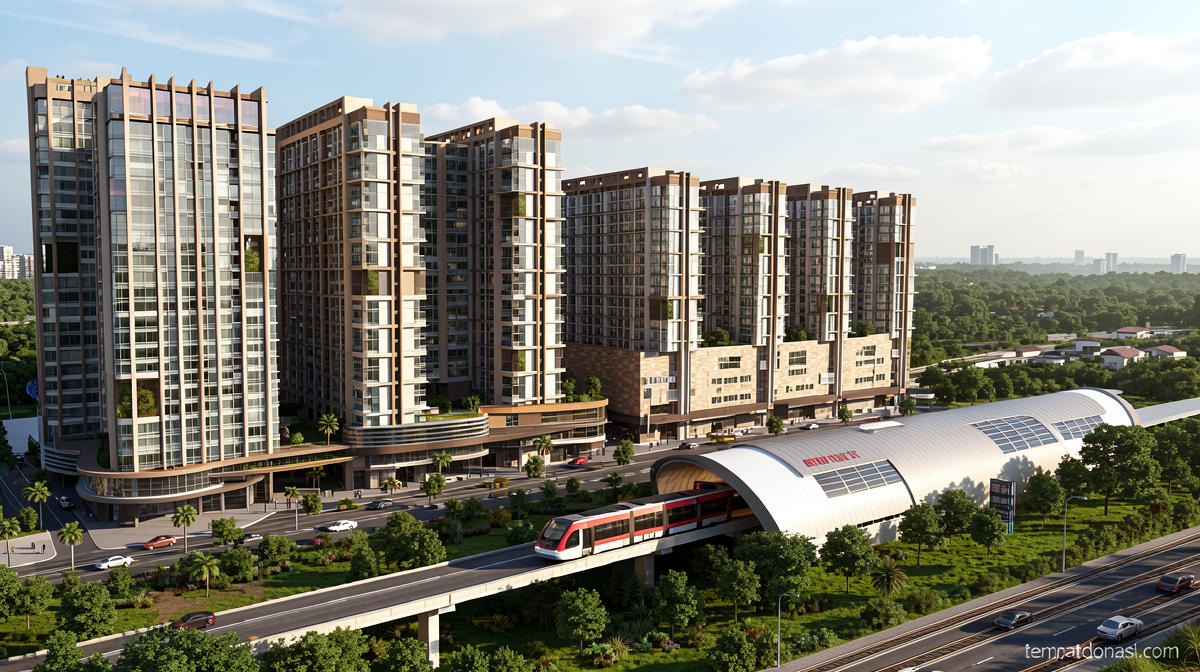
At its core, LRT City is a transit-oriented residential concept: clusters of apartment towers and mixed-use developments sited within walking distance of rail stations. The program straddles both the Commuter Line (KRL) network and the integrated Jabodebek Light Rail Transit (LRT) system, which links Jakarta, Bogor, Depok, and Bekasi. The design logic is straightforward — reduce car dependency by placing housing where rail already runs.
ADCP’s own project catalogue lists roughly 12 distinct developments spanning approximately 142 hectares. The portfolio includes LRT City Ciracas, LRT City Cibubur, LRT City Jatibening, LRT City MTH, LRT City Tebet, LRT City Bekasi Eastern Green, LRT City Bekasi Green Avenue, LRT City Cikunir, Grand Central Bogor, Oase Park, Cisauk Point, and Adhi City Sentul. Together they represent one of the largest single-developer residential footprints in the Greater Jakarta area, and their collective delay amplifies the social stakes well beyond any single tower.
Ministerial Response and Audit Escalation
Speaking at the Parliament Complex in Jakarta on Wednesday, September 2, 2026, Maruarar outlined the next steps. The ministry intends to convene both the original developers and any successor firms now attached to the project, ensuring that every party with operational knowledge is heard before decisions are finalized.
“We will summon them. We are committed to protecting the people’s rights,” he said.
Maruarar urged caution in how the government proceeds, advising that officials listen carefully to explanations from both the old and new developer teams while weighing the audit findings already produced by BPK and BPKP. The minister framed the approach as one of informed judgment rather than reflexive blame, acknowledging that the root causes may be layered — financial, administrative, and contractual.
Danantara Enters the Picture
In parallel with the audit track, the Ministry of Housing has opened a channel with Danantara, Indonesia’s sovereign wealth fund, to explore capital solutions. Maruarar disclosed that Danantara has prepared a capital injection scheme exceeding Rp400 billion earmarked for the LRT City project, though specific disbursement mechanics were not detailed publicly.
Danantara Chief Operating Officer Dony Oskaria confirmed the fund’s involvement on a separate occasion at the Parliament Complex, Senayan, on Monday, August 31, 2026. He stated that Danantara would also summon Adhi Karya, the parent company of ADCP, to align on a remediation pathway. The figure Dony cited for the assistance package was Rp456 billion.
“It will be finalized this month and we will submit it to Adhi Karya so that the housing project can resume,” he said.
The sovereign wealth fund’s entry into the conversation is notable. Danantara was established to channel state capital into strategic sectors, and its willingness to backfill a stalled residential development underscores how politically sensitive the LRT City delays have become. For buyers who have already paid substantial down payments or taken housing loans, the prospect of a state-backed capital injection offers a degree of reassurance — though it does not erase the months of uncertainty already endured.
What Adhi Karya and ADCP Say
On the corporate side, Adhi Karya has indicated that several remediation schemes are under internal review, with the stated objective of allowing consumers to receive their residential units as quickly as possible. A company representative summarized the posture bluntly:
“We will opt for the fastest solution.”
In a disclosure filed with the Indonesia Stock Exchange, Achmad Wachid Abdullah, Finance Director of Adhi Commuter Properti, offered a more granular explanation of the delay. He stated that physical construction on the project was effectively completed in 2023, but the handover process has been obstructed by an incomplete certificate deed procedure. In practical terms, the legal documentation required to transfer ownership and occupancy rights has not been finalized for all units, largely because the apartments have not yet been fully sold. Until the deed process closes, buyers cannot formally take possession.
Achmad added that handover has nonetheless proceeded for qualified customers whose transactions are complete, and that a number of units are already occupied.
“Some of the customers who have received the handover have already moved into the apartments,” he said on Friday, August 14, 2026.
Why This Matters Beyond the Individual Buyer
The LRT City saga sits at the intersection of three national priorities: affordable urban housing, transit-oriented development, and public trust in state-linked enterprises. Jabodebek’s rail expansion was sold to citizens as a decongestion strategy, and the housing that anchors those stations was meant to make the strategy self-sustaining. When the towers stand finished but empty — or finished but legally inaccessible — the transit investment’s social return is deferred, and the political cost of that deferral falls squarely on the government.
The simultaneous involvement of BPK, BPKP, the Ministry of Housing, and Danantara suggests that Jakarta’s leadership is treating the matter as a multi-track crisis: audit, capital, and operational remediation running in parallel rather than sequence. For the thousands of families whose savings are tied up in these units, the question is no longer whether the government will act, but how quickly the combined weight of those institutions can convert a completed building into a livable home.
Related Reading
Frequently Asked Questions
What is What to Know About the LRT City?
What to Know About the LRT City is the main topic of this guide. The article explains the context, practical details, and next steps readers should understand.
Why does What to Know About the LRT City matter?
What to Know About the LRT City matters because readers are looking for a useful answer, not just a short summary. Good content should match search intent and help them decide what to do next.