

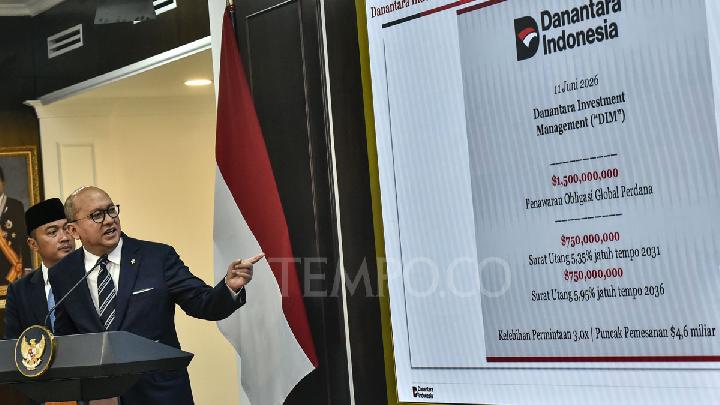
Risks Behind Danantara’s US$1.5 Billion Global Bond
Risks Behind Danantara s US 1 5 – TEMPO.CO, Jakarta — The Center of Economic and Law Studies (Celios) has expressed concerns over the bond issuance by PT Danantara Investment Management, which amounts to US$1.5 billion or approximately Rp26.5 trillion. The organization warns that this financial move could create new challenges, particularly in terms of interest obligations and their potential impact on state-owned enterprises (SOEs) and the broader fiscal framework.
Criticism of Quasi-Fiscal Practices
Celios Executive Director Bhima Yudhistira highlighted the risks associated with Danantara’s debt issuance, emphasizing its role in funding projects that might otherwise be supported by the state budget. “By covering part of the National Strategic Project (PSN) through private borrowing, Danantara is effectively assuming quasi-fiscal responsibilities that could burden the public sector,” Bhima stated in a statement released on Saturday, June 20, 2026.
“Part of the National Strategic Project (PSN) is being funded by Danantara rather than the state budget, creating quasi-fiscal risks,” Bhima noted.
The think tank’s analysis suggests that this shift could lead to a situation where SOEs are forced to bear the costs of government obligations, potentially reducing their capacity to generate dividends. Bhima further warned that if interest payments on the bond become significant, they could divert resources from essential corporate activities and create a hidden financial strain on the state.
Exchange Rate and Liquidity Risks
Celios also raised alarms about the implications of issuing a large sum in foreign currency. The organization pointed out that the bond’s foreign denomination exposes the company to fluctuations in exchange rates, which could complicate repayment schedules. Additionally, the mismatch between short-term debt tenors and long-term investment goals poses a liquidity challenge, as the funds are allocated to projects with extended payback periods.
According to Celios, the lack of transparency regarding the bond’s use of funds has heightened these concerns. The think tank questioned whether the borrowed capital would be distributed efficiently or if it might be misused to prop up struggling energy SOEs already grappling with government compensation costs. Bhima illustrated the issue with an example: when the government delays fuel or electricity tariffs, companies like Pertamina or PLN often cover the difference upfront, adding to their financial strain.
CEO’s Perspective on Investor Confidence
Despite these warnings, Danantara’s Chief Executive Officer Rosan Roeslani defended the bond issuance, citing strong global demand. He revealed that the offering was oversubscribed more than three times, signaling robust international interest in Indonesian financial instruments. “The high level of subscription demonstrates confidence in our ability to manage this debt effectively,” Rosan stated.
“Government obligations, such as maintaining subsidized energy prices and funding price differentials, could be transferred as burdens to SOEs. For example, when the government holds back fuel or electricity tariffs, Pertamina or PLN will pay the compensation costs upfront,” Bhima noted.
Rosan also provided details about the bond’s structure, explaining that the proceeds are divided into 5-year and 10-year tenors, with each portion absorbing US$750 million. This split was intended to balance short-term obligations with long-term growth strategies, though critics argue it may not fully mitigate the risks.
Danantara initially aimed for a US$1 billion debut issuance but scaled it up after a surge in investor interest. Following a series of roadshows in major financial centers, the demand for the bond exceeded expectations, prompting the company to increase the issuance to US$4.6 billion — roughly Rp81.5 trillion at the time of the exchange rate of Rp17,725 per US dollar.
Asset Claims Under Scrutiny
Another point of contention is Danantara’s claim of holding US$1 trillion in assets. Celios questioned the validity of these figures, noting that the liquidity and risk exposure of each asset class remain unverified. “If these assets are not as robust as claimed, the debt issuance could lead to cascading interest costs that squeeze dividends from SOEs,” the think tank emphasized.
With such a substantial amount of debt, the focus has shifted to ensuring that the funds are used for their intended purpose. Critics are particularly concerned about the possibility of capital injections into energy SOEs, which are already under pressure due to government subsidies. Bhima warned that if the bond proceeds are redirected to address these existing debts, it could perpetuate a cycle of financial dependency.
Implications for Indonesia’s Financial Landscape
The bond’s success has underscored the growing appetite for Indonesian debt in international markets, but it has also intensified scrutiny over the country’s fiscal strategy. While the oversubscription suggests a positive reception, analysts stress the importance of careful management to prevent the bond from becoming a conduit for hidden government liabilities.
Some experts argue that Danantara’s bond issuance reflects a broader trend of private entities assuming roles traditionally held by the public sector. This could be beneficial for diversifying funding sources, but it also raises questions about the long-term sustainability of such models. If the company fails to meet its repayment obligations, the consequences could ripple through the state budget and affect public services.
As the bond enters the market, stakeholders are closely monitoring its performance. The initial target of US$1 billion was surpassed, but the final amount of US$1.5 billion means the financial implications are more pronounced. For Danantara, this move is a test of its ability to navigate complex debt structures while maintaining transparency and efficiency in fund allocation.
Broader Economic Concerns
Celios’ concerns are not isolated. Other financial analysts have echoed similar worries about the risks of leveraging foreign currency debt to fund strategic initiatives. They point to the potential for inflationary pressures, as increased borrowing could lead to higher interest rates or currency depreciation. Such scenarios might indirectly impact the cost of living and the budgets of SOEs.
Furthermore, the bond’s success could signal a shift in investor sentiment toward Indonesia’s economic stability. However, if the country’s fiscal policies remain inconsistent, the long-term viability of such investments may come into question. The challenge for Danantara lies in proving that its financial strategy is not only sound but also aligned with the broader economic goals of the nation.
As the bond’s proceeds are distributed, the effectiveness of Danantara’s approach will depend on its ability to balance immediate needs with long-term stability. The organization must demonstrate that its assets are resilient and that its debt management plan accounts for potential market volatility. For now, the focus remains on the short-term risks, but the long-term consequences could shape Indonesia’s economic trajectory for years to come.
Read: Danantara on Prabowo-State Bank Bosses Palace Meeting Click here to get the latest news updates from Tempo on Google News.