
Fact Check: Can Indonesia Withstand a Long Drought With Current Rice Stocks?
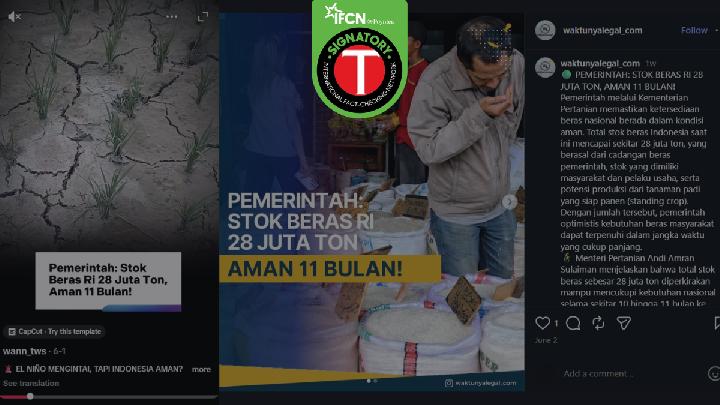
Fact Check – Indonesia faces concerns over its ability to sustain rice supplies during an extended period of drought, according to recent claims circulating on social media. A TikTok video and Instagram post argue that the country’s rice reserves are sufficient to last for the next eleven months, even with the anticipated effects of El Niño. The posts highlight footage of President Prabowo’s agricultural activities, scenes of rice harvests, and images of Bulog warehouses filled with sacks of rice. The account holder asserts that as of April 7, 2026, rice reserves in Bulog warehouses totaled 4.6 million tons, with the overall national stockpile reaching 28 million tons. They further claim that these reserves are secure for the next 11 months, thanks to a combination of stored rice, crops ready for harvest, and rice circulating in the public market.
Government Claims and Rice Stock Breakdown
Deputy Minister of Agriculture Sudaryono confirmed the government’s position, stating that the 28 million-ton figure encompasses rice stored in Bulog warehouses, commodities nearing harvest, and rice that is already in circulation. However, this assertion has sparked debate among agricultural experts, who question the reliability of the data and the underlying assumptions. According to the Ministry of Agriculture, the stockpile is enough to meet national demand for 324 days, or roughly 10.8 months, as stated by Minister Andi Amran Sulaiman on March 6, 2026. While this projection appears optimistic, it does not account for the full complexity of supply chain logistics during prolonged dry spells.
Amran’s March 2026 statement emphasized that the nation’s food security remains intact despite global geopolitical tensions and the potential for climate phenomena like El Niño and drought. At the time, the national rice availability stood at 27.99 million tons, a combination of Bulog’s 3.76 million tons, community-held stocks of approximately 12.50 million tons, and ready-to-harvest crops amounting to 11.73 million tons. Yet, the figures are not without controversy. Agricultural observers point out that the method of calculating these reserves is unclear and may include estimates that are difficult to verify.
Rice Stock Data Questionable
Khudori, a former member of the Food Security Council Working Group, raised concerns about the accuracy of the government’s rice stock calculations. He noted that the claim of 12.50 million tons in public stocks is hard to substantiate, and the availability of these reserves remains uncertain. “Anything can happen from planting to harvest,” Khudori told Tempo on June 11, 2026, highlighting the vulnerability of the supply chain during drought conditions. Similarly, Adhitya Wardhono, a lecturer at the Faculty of Economics and Business at the University of Jember, criticized the way the government categorizes rice stocks. He pointed out that some reserves are still with the public, while others are crops yet to be harvested, creating ambiguity about their immediate usability.
The debate extends to how the government defines “ready-to-harvest” rice. While the 11.73 million tons of standing crops are included in the stockpile, their condition and readiness for distribution depend on factors such as water availability and weather patterns. Khudori emphasized that without reliable access to water, these crops may not be harvested on time, reducing their contribution to the national supply. This uncertainty challenges the assumption that current stockpiles alone can mitigate the risks of a prolonged drought.
El Niño and the Timeline of the Dry Season
The Meteorology, Climatology, and Geophysics Agency (BMKG) projected that the dry season would peak between July and September 2026, with El Niño conditions expected to persist into early 2027. This prolonged period of warm ocean temperatures in the central and eastern Pacific Ocean could disrupt rainfall patterns and increase the likelihood of crop failure. Experts warn that if the drought extends beyond the peak season, the impact on rice production may be severe, particularly for farmers relying on rain-fed agriculture.
Amran Sulaiman’s March 2026 remarks, which the TikTok video amplified, were made in the context of global climate uncertainties. While he assured that rice stocks were sufficient to withstand potential disruptions, the actual resilience of these reserves depends on the timing and severity of the drought. Adhitya Wardhono pointed out that the government’s strategy hinges on the assumption that rice will be available for distribution during the dry season. However, if the drought leads to water shortages in key agricultural regions, the ability to maintain stock levels may be compromised.
External Risks and Distribution Challenges
Experts caution that even with ample stockpiles, Indonesia’s rice market may not remain stable during the dry season. Eko Sumartono, a lecturer at Dehasen University’s Agribusiness Study Program, highlighted that warehouse stocks do not automatically guarantee consistent retail prices. He explained that external factors such as disruptions in the distribution chain, hoarding by private actors, and shifts in market speculation could drive prices up significantly. “Rice prices at the consumer level could soar beyond the highest retail price,” Eko stated on June 10, 2026, underscoring the need for proactive measures to prevent inflationary pressures.
One of the key challenges is maintaining the quality of stored rice during a long dry season. Bulog warehouses must ensure that the rice remains free from moisture damage and pests, which could reduce its shelf life and usability. Additionally, the government faces the task of managing distribution efficiently, ensuring that rice reaches both urban and rural populations without shortages. Adhitya Wardhono stressed that the real test lies in how well the authorities can coordinate with local farmers and traders to maintain a steady flow of supplies.
Strategies for Mitigating Drought Impact
To safeguard against potential shortages, the government must implement tactical interventions. Eko Sumartono suggested that water supply mitigation, such as pumping river water into dry rice fields, is essential to prevent crop failure. Without such measures, the prolonged drought could lead to a significant reduction in rice production, threatening the stockpile even after the dry season ends. He also emphasized the importance of increasing the cropping index (IP) by encouraging land optimization, allowing farmers to plant at least twice a year (IP200) before the extreme drought peaks in August.
These strategies require collaboration between the Ministry of Agriculture, local governments, and the private sector. Farmers need access to water and resources to maintain productivity, while traders must avoid hoarding and ensure fair pricing. The success of these efforts depends on the government’s ability to monitor the situation closely and adapt to changing conditions. As the dry season progresses, the country will need to rely on both existing reserves and new harvests to meet demand, making the coming months critical for assessing the effectiveness of its food security plan.
In summary, while the government asserts that current rice stocks are sufficient for the next eleven months, the situation remains complex. Experts like Khudori and Adhitya Wardhono question the accuracy of the data, pointing to the difficulty of verifying public stocks and the risks associated with unharvested rice. Meanwhile, Eko Sumartono highlights the necessity of distribution strategies and external interventions to prevent price volatility and supply chain disruptions. As El Niño conditions continue, the true test of Indonesia’s resilience will depend on its ability to balance stock management, production sustainability, and market stability. The coming months will reveal whether the nation can effectively navigate the challenges of a long drought.